
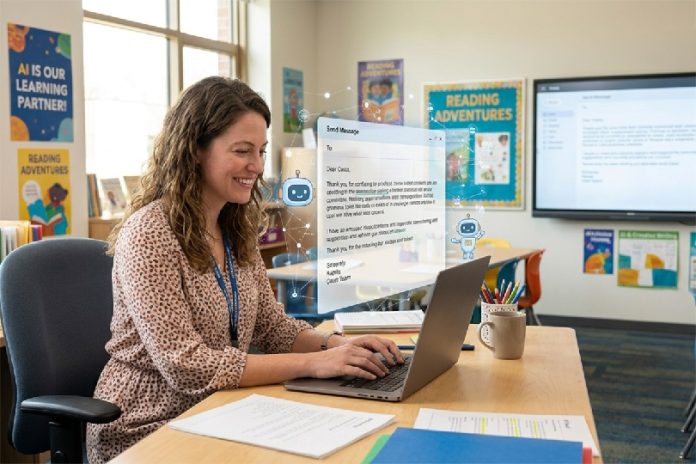

Most news reports about the use of artificial intelligence in schools center on misuse, such as cheating or plagiarism. But two local school districts are looking at how the technology can be a boon to teachers.
Arlington Public Schools and Fairfax County Public Schools are testing the waters with generative AI—GenAI, for short. It’s a subset of AI that creates new content, including text, images and audio by learning patterns from massive datasets. Common platforms include OpenAI’s ChatGPT, Microsoft Copilot and Google Gemini. Think of them like very souped up chatbots that can respond to queries conversationally.
Although GenAI has been around for decades, usage spiked after ChatGPT emerged in late December of 2022. Within five days, ChatGPT had 1 million users. As of July 2025, 10% of the world’s adult population said they use it, making it the most used AI chatbot. A 2025 study by Elon University found that more than half of U.S. adults use GenAI.
FCPS Tests ChatGPT for Teachers
In December 2025, OpenAI launched ChatGPT for Teachers, a secure workspace designed for educators and available to them for free through June 2027. The company tapped FCPS, which includes schools in McLean and Falls Church, to be part of the first cohort of school districts in the country to try it. (Prince William County Public Schools and 14 others nationwide are also part of the first group, which encompasses about 150,000 users.)
“Many of our children are already using AI for different purposes, and we want to make sure that our adults—our educators and operational staff—have an opportunity to learn more about the tools, actually use the tools and begin to develop some skills that will enable them to be a greater part of the conversation as we think about shaping a measured approach to this work and also an ethical use for this work,” says FCPS Superintendent Michelle Reid.
In announcing the partnership in a letter to the community, Reid wrote: “AI will never replace the heart of teaching or the human connections that are foundational to the high-quality education we provide all our students. But AI can remove barriers, save time, and open doors to new ideas and spark innovation in the classroom and beyond.”
How AI Can Help
All of FCPS’s 25,000 teachers and 40,000 staff members can try it. Gautam Sethi, FCPS’s chief information technology officer, says he expects ChatGPT for Teachers to help the most with reducing mundane, repetitive activities. So far, usage is growing: The number of users doubled from about 4,000 in January to about 8,000 in March.
“The best time a teacher can spend is time talking to a student,” Sethi says. “The key is, what can you offload reliably to this technology and trust it it to do? It could be a lesson plan, it could be writing emails to parents or any number of points that take time and are not necessarily core or critical to operations.”
Ultimately, he says, it’s about determining where ChatGPT for Teachers adds value. To evaluate that, FCPS is using focus groups and studying usage data to determine areas of high and low demand. That analysis will begin after a few months of sustained usage.
APS Takes on AI
APS is not using ChatGPT for Teachers, but for the 2025-26 school year, it provided educators with access to other GenAI tools, including Copilot, Gemini, Google NotebookLM and SchoolAI. The idea is to get them comfortable with GenAI and establish clear expectations for ethical and transparent use, says APS Director of Communications Frank Bellavia.
“Our priority has been to adopt AI in a way that is instructionally meaningful, safe for students and aligned with our values,” Bellavia says.
The school district also has invested in professional training on AI. This year, educators are completing self-paced and in-person AI literacy and responsible use courses. Last year, APS launched a three-part course called AI for Educators.
“This training prepares teachers to use AI for planning, differentiation, feedback and instructional design while also modeling transparency, ethical use and academic integrity with students,” Bellavia says.
Also last year, APS started a districtwide initiative called the Year of AI Empowered Learning for 2025-26 to understand current and potential AI use in the school system. As part of that, APS developed a living guidance document on GenAI to serve as a framework for use and adoption.
The guidance includes seven principles for GenAI use. One is on support for teaching and learning, such as by complementing teacher expertise. Another homes in on professionalism and operational efficiency. That includes being critical of GenAI’s limitations and understanding how the tools work.
Prioritizing Security
Data privacy and security are top concerns relating to GenAI, which relies on data to learn and generate answers. Recognizing that, another of the seven principles in APS guidance is around privacy, security and safety to prevent the unintentional release of personal information for students or staff.
“Before any digital tool is approved for instructional use, it must meet strict criteria for cybersecurity, student data privacy, and compliance with FERPA and COPPA,” Bellavia says.
The former refers to the Family Educational Rights and Privacy Act, which protects student education records. The latter is the Children’s Online Privacy Protection Act, which regulates how online services collect, use and disclose personal information about children younger than 13.
FCPS, which also uses Google Gemini, is prioritizing security. “Whatever our staff does within the scope of FCPS’ partnership [with OpenAI], that would not be used for any purposes of training the model or seen by their staff,” Sethi says.
“This is a measured approach we’re taking, and it’s our first step is making sure our adults have stronger skills,” Reid adds. “We want to make sure we’re part of the conversation moving forward that’s going to shape the use of AI, not just in our classrooms and schools and businesses, but really across the globe.”