

I have always been fascinated by pawn shops. The few I visited as a kid with my father smelled of diesel fuel and featured greasy tools and combat knives in messy display cases. There was a mystery to these places, I believed—untold stories to go along with the trays of wedding bands and embossed leather bibles.
As a longtime fan of shows like the History Channel’s Pawn Stars and (no judgement, please) truTV’s Hardcore Pawn, I was dying to get behind the scenes. I finally scratched that itch last spring by working a shift at Royal Pawn on 23rd Street in Crystal City.
It all started when I met pawnbroker Matt Fantz while browsing the Georgetown flea market. In front of him was a single foldout table, more suitable for a game of three-card monte than the Native American jewelry and odds and ends he was selling. I purchased an old Navajo brooch, and we got to talking.
When he told me the items on the table came from the shop where he worked, I wondered aloud what it would be like to have that job. I was curious to learn who, exactly, might seek out a place like Royal Pawn for odd treasures or quick cash.
“You should come by and check it out,” Fantz said, handing me a business card with the owner’s name in small font across the front: Nick. No last name.
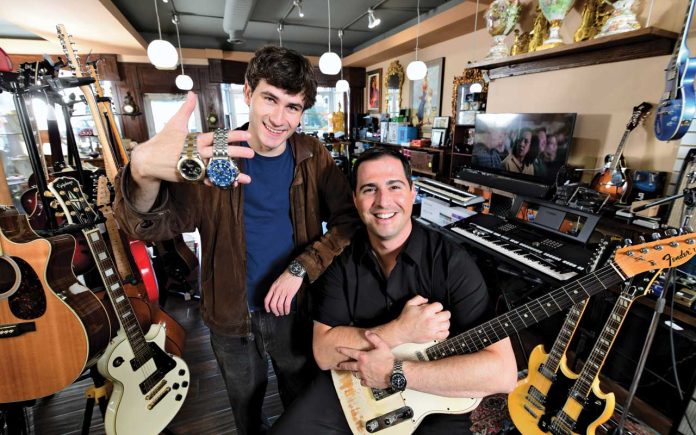
Arriving at the shop a few weeks later, I discover, to my great relief, that there isn’t a greasy lawnmower or a Chumley—the ditzy, sausage-fingered employee on Pawn Stars—in sight. “Well, not today at least,” quips Fantz, who is behind the jewelry counter arranging a ring tray. Dark-haired and mustached, he looks a bit like pop star Benson Boone, minus the sparkly blue jumpsuit.
We’re soon joined by proprietor Nick (last name Rizer), who is dressed in black and wearing a massive gold chain. He has gamely agreed to let me pull a shift.
It’s not even noon and already there’s drama: Nick has just hung up the phone with his brother, Alex, who runs their sister shop in Franconia. Alex called with a warning about a guy with a watch—a Rolex Submariner.
Upon opening the watch, Alex noticed something was off. Instead of displaying one counterbalance, this one had two—a telltale sign that it was a fake. The staff needed to be on high alert in case the watch hawker made the 10-minute trip from Franconia to Arlington to try again.
As pawnbrokers, the Rizer brothers need to be generalists, knowing a little bit of everything, from designer timepieces to fine porcelain to sports memorabilia. They learned the business from their father, Eric, who learned the ropes from his mother, a former antiques dealer from England. She’s the one who convinced Eric, then working as a manager at a local Giant Food, to open the Franconia shop in the early ’90s. The Arlington store has been in operation since 2017 with Nick at the helm.
Eric, now retired, busies himself with his Grey Lady Farm out in The Plains, where he and his wife, Nancy, breed and raise thoroughbred racehorses. Among them is a horse named Nick’s Notion, a favorite for obvious reasons.
As the morning unfolds, two-legged Nick is approaching a different sort of finish line. He’s jockeying to close a deal with his first customer of the day, a dog walker who is busy spreading out some of her mother’s fine jewelry on the counter. “We’re Venezuelan,” she says by way of introduction. “The amount of gold you get over there is staggering.”
The woman’s mother died recently, she explains, and she needs money to have her mom’s collection of paintings professionally appraised. “I have about $30K of art in my basement,” she estimates.
Rizer separates the gold into karats—a pile of 10k, a pile of 14k—and hands over $1,200. The haggle-free purchase takes less than 10 minutes.
“I always plan for future business,” he says shrewdly. Maybe some of that artwork will eventually make it to the shop. The goal is to turn each customer into a return customer.
Next, a family of seven, in from New England to see the cherry blossoms, wanders in. Royal Pawn gets a lot of foot traffic from tourists, given its proximity to several hotels. Rizer shows some of the men a tray of pocketknives. The family’s patriarch slides over to me and whispers, “That guy really knows his stuff.”
The day brings a steady stream of buyers and sellers. A conference attendee from Las Vegas looks at a $10,000 diamond bracelet and a royal blue Hermes Clic Clac cuff that she ultimately deems, “Not my color.” A trio of 20-somethings has driven over an hour to buy a guitar that Fantz listed the day before on Facebook Marketplace.
Fantz started out as a patron at Royal Pawn when, at 19, he came in to check out some guitars. He and Nick both play, taking turns noodling around on a 2020-era Martin whenever there’s a lull in store traffic. The basement of Royal Pawn is a man cave extraordinaire, loaded with electric and acoustic guitars, speakers and amps. Hanging on the wall is a gigantic sign from Zavarella, the music shop that once occupied the building.
Aside from the shoppers and lookie-loos, a few customers stop in to extend their loans. While the majority of store transactions involve cash in exchange for goods (which the shop then sells at a markup), some customers put down valuables as collateral on short-term loans, paying 10% interest every 30 days while their pawned items are kept locked in a vault.
“When the economy’s not doing well, we’re taking in items,” Nick explains. Unlike most retail operations, there is no busy season. “Some days are big sale days.”
The guy with the fake Rolex never shows up. As my shift ends, a woman comes in and empties out a small pocketful of jewelry on the counter. Amid the dainty silver earrings and delicate chains is a small gold heart set with teensy diamonds. She leaves few minutes later, $72 dollars richer.
Heart in hand, Fantz grabs a Sunshine cloth and begins polishing. Pretty soon, it looks like a million dollars.
Cathy Alter’s articles and essays have appeared in The Cut, Oldster, Wired and The Washington Post, among others. She lives in Washington, D.C., with her husband, Karl, their son, Leo, and Benny the cat.