

Recently, a friend sent me a one-word text—“Whoa!”—along with a seemingly nondescript photo of a silt fence, a pile of rubble and a tall tree reaching high into a pale blue sky. There was no street sign, no house number painted on the curb that might give away the location, yet I understood what the heap of concrete in the picture represented. It was a funeral pyre waiting for a match.
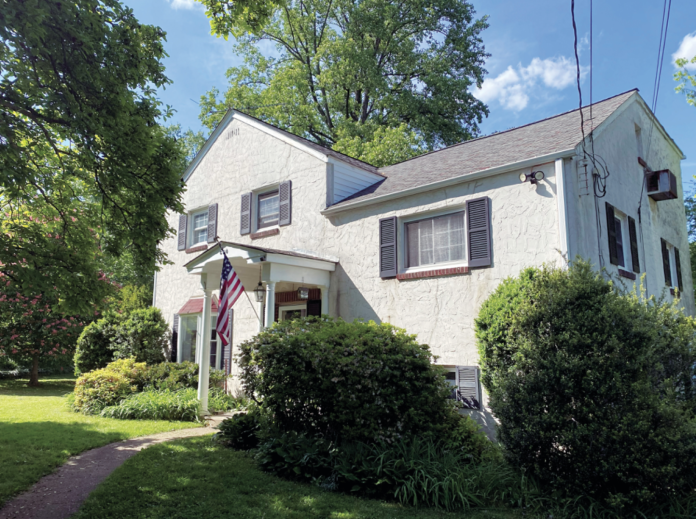
My friend moved to the City of Falls Church only a decade ago, so she couldn’t have known that the enormous tulip poplar in the photo once had two equally majestic siblings along the edge of a half-acre lot that gently rolled like a fairway. In the mornings, those towering centenarians provided shade for two horses nibbling grass in a paddock across the road. Come afternoon, their swaying canopies dappled the house of my youth—a white stucco split-level with a curved sidewalk leading to a front door that was usually open.
Dogwoods and fruit trees formed an understory on our corner lot. In early summer, my brothers and I would tie a canvas hammock between two pear trees. In the fall, my dad would climb an apple tree and shake its limbs, precipitating a hailstorm of fruit that we bagged and carried inside like sacks of loot to my mother, who sliced it up for pies and cooked down the rest for applesauce.
If the side yard along Great Falls Street formed an orchard, our backyard was a playground. I only vaguely remember my little brother sitting in a sandbox, but I vividly recall pushing the limits of an old swing set like a 6-year-old Icarus. My dad added a basketball hoop, and for years my brothers and I scuffed the grass and pounded the ground into a hard-packed dirt court, just right for a quick game of H-O-R-S-E.
A gnarled old mulberry in the corner yard is where Dad built the finest treehouse in the neighborhood as a birthday gift for my little sister. She would have been about 8 or 9. Dad ran electricity to the hideaway and installed a light so she could escape for some peace and privacy—the kind the only girl in a house full of boys probably struggled to find.
When I think of that yard and the home it surrounded, I remember feeling safe. All sorts of things were added (two little brothers! a sister!), but rarely was anything taken away.
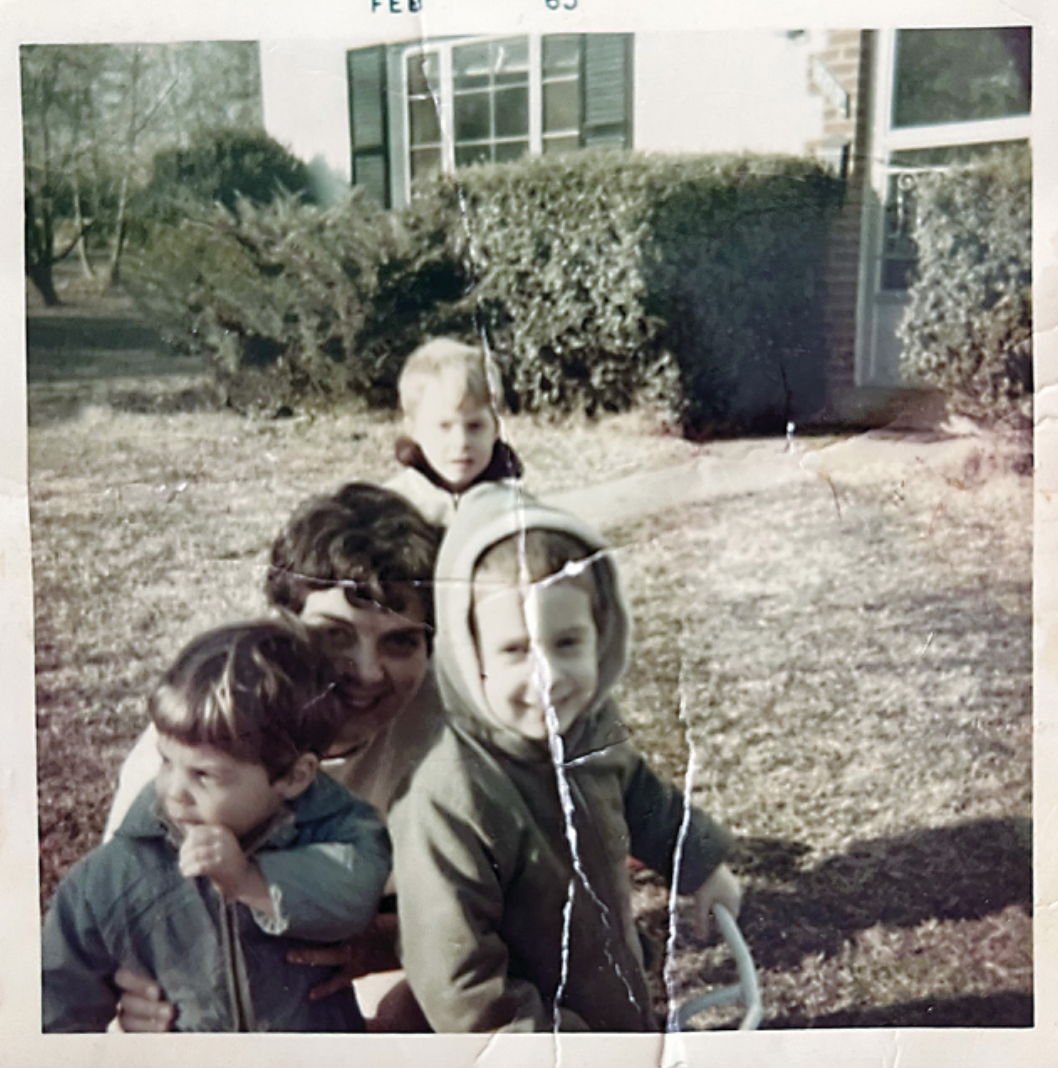
My first experience with loss came at age 5 or 6. I was outside with my brothers, petting our big German Shepherd, Wotan. My dad had gotten him as a puppy before I was born, so the dog was as much a part of my world as the trees and my parents.
Dad didn’t tell us where he was going as he led Wotan through the gate and into the back of our red Ford Galaxy station wagon, but I remember the sadness I felt. I somehow knew that Wotan was going away and would not be coming back. It would be another 40 years before I took my own old dog on a one-way trip to the same Falls Church vet and understood what Dad had done, and endured, that afternoon.
Over time, our property evolved—sometimes slowly and naturally, other times suddenly and shockingly. I returned home from college one weekend around 1980 and was stunned to find that VDOT had chopped down the twin poplars as part of a project to widen Great Falls Street. What had been a narrow, two-lane road was now a four-lane ramp to a bridge spanning the new and long-contested interstate highway that had gashed our neighborhood behind our back fence.
My sister’s treehouse could have served as a crow’s nest to watch the highway construction, but the demolition of those familiar surroundings left us in no mood for a bird’s eye view of the march of “progress.”
As she does, when given sufficient time, Mother Nature healed the yard (and maybe us, too), with help from my father and mother. Dad took cuttings of forsythia and rose of Sharon from the side yard along Great Falls Street and cultivated a hardy hedge that lent privacy to our reconfigured property. Mom added bulbs, day lilies and Lenten rose to create a lush embankment.
With the poplars gone, an abundance of newfound sunlight gave rise to a small tulip magnolia that grew a little bigger each year, eventually dominating the front yard with not only a broad canopy, but an exquisite fragrance that my mother would invite indoors by opening all the front windows at the first sign of spring.
Around the same time that I-66 was built, a hurricane took down a weeping willow that had shaded our patio. Dad responded by planting wisteria, which he trained up and over an arbor he’d built as an elegant setting for al fresco family dining.
When another storm felled a companion willow on the opposite side of the house, Mom and Dad cultivated a rose garden in its place. In 1985, they capped that garden with a white rose bush to memorialize my sister, whom we lost suddenly and tragically that year.
To our friends, our home must have seemed impossibly full. We were a family of six when we moved to Falls Church in September 1961 (I was eight months old), and we topped out at nine with my youngest brother’s arrival in 1966. While a vacant room was rare, the house never felt crowded to me. Sure, the galley kitchen was tight, but the living room was large and the dining room felt even larger—even when nine of us squeezed around a table built for eight.
Over 19 years, that table was the setting for countless anniversaries and birthday celebrations. I was a teenager when we feted my grandfather’s 75th. Two decades later, I was a new dad when we marked my father’s 70th trip around the sun.

Today, I am halfway through my own seventh decade. The milestones that once felt foreign—and the perspectives that accompany them—are no longer unimaginable. They are virtually inescapable.
The late afternoon light on the pile of rubble in my friend’s photo suggests stillness and silence. But for me, it doesn’t evoke sadness. Rather, the image brings to mind the stump at the conclusion of Shel Silverstein’s The Giving Tree. The lush yard, the house and my parents, both of whom quietly passed away there, gave all they had to make 6710 Hallwood Avenue a warm refuge from a larger world that—as life has taught me (and, I suppose, teaches us all)—can sometimes seem cold or uncaring.
Were I not living in Charlottesville these days, I might have been inclined to dig through that pile of rubble, to unearth a few red bricks, knowing I’d found what remained of the chimney. In the early 1960s, my dad framed the hearth with built-in bookshelves, and for a few days each year, we draped our Christmas stockings there. Otherwise, the space was perpetually laden with artwork, figurines, greeting cards and photos—first of children, then grandchildren and, later still, great-grandchildren. The mantel and the bookshelves were always overflowing, but never so much that there wasn’t space for another portrait, another birthday card.
By now, the pile of rubble in the photo is surely gone, never to return—like old Wotan, like the trees and the rose garden, like my parents and my sister. But my memories endure. They are warm and sustaining. And like birthdays celebrated around an old wooden dining room table, they are crowded with abundant gifts of love.
Mike Moriarty is retired and lives in Charlottesville. He has been published in C-VILLE Weekly, the Pittsburgh Post-Gazette, SwimSwam, and Substack.