
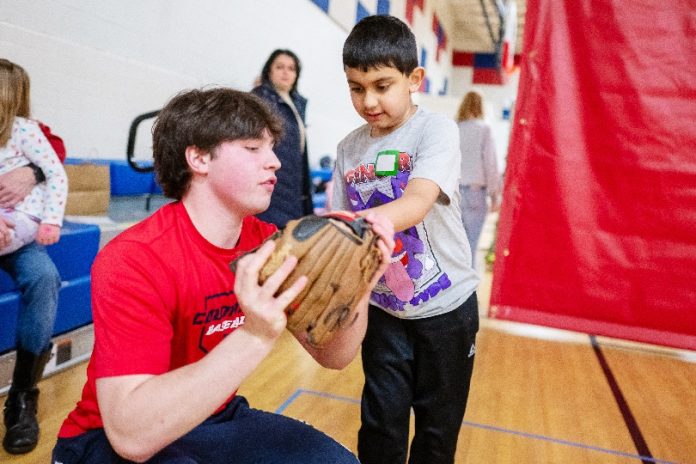

The Thomas Jefferson High School for Science and Technology’s baseball team hit a four-bagger with their first-ever Adaptive Baseball Camp.
Open to 6- to 16-year-olds with intellectual and developmental disabilities, the sports camp welcomed 28 campers to three two-hour sessions in February. All members of both the varsity and JV baseball teams volunteered to help with at least one session.
“My kids absolutely loved it,” says Sarah Vavredge, a Springfield resident whose 8-year-old son, Bentley, and 6-year-old daughter, Lilly, attended all three. Both have autism and ADHD. “Finding a place where my kids can thrive is often really hard. I loved seeing my kids happy and included, and also that I could sit down. Normally if we participate in anything, I have to be right beside my kid.”
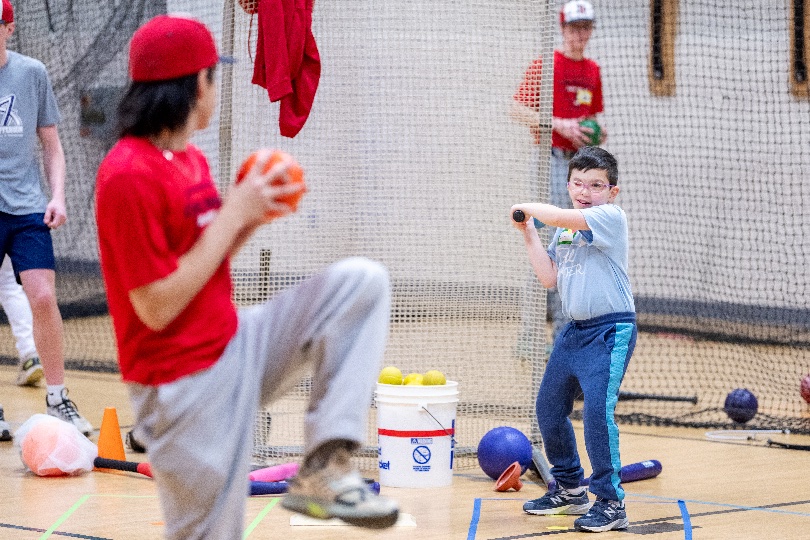
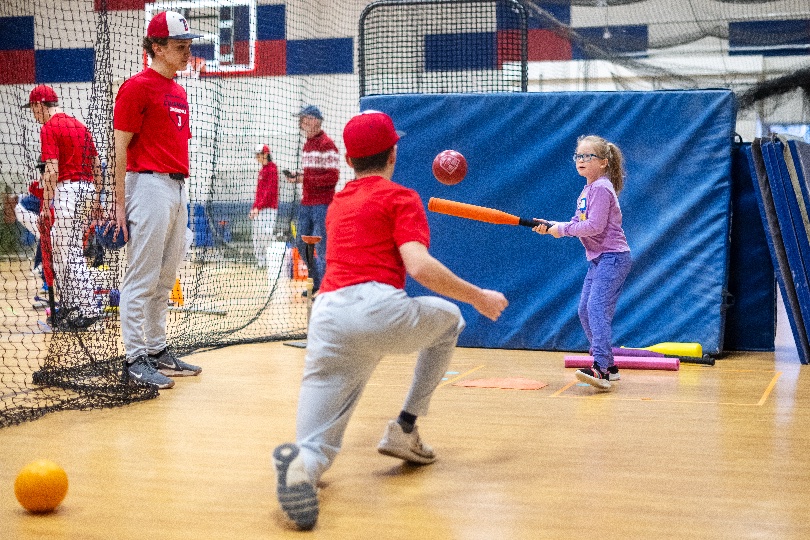
With a focus on honing introductory skills, the team split the school’s auxiliary gym in two. Stations for hitting and running bases were on one side, stations for throwing and catching on the other. On arrival, each camper was paired with a player. Together, they rotated through the stations, giving the kids time to get to know each other.
Everyone adapted as needed, says Jennifer Hammond, who became the first woman to lead a varsity baseball team in Virginia when she took the job at TJHSST last fall. For example, some kids hit beach balls while others swung at smaller ones.
“Each station had its own adaptability and its own scale in terms of challenge and each specific player’s interest and ability,” Hammond says. “At the end of each session, we would bring everyone together for a game. We set up little mini fields and let them hit and run the bases.”
Throwing Out The Pitch
The camp was the brainchild of Andrew Haydon a junior at TJHSST, and his mom, Carolyn. A varsity baseball player since his freshman year, Haydon was looking for ways the team could fundraise. Whereas other Fairfax County high school sports teams offer developmental clinics for younger students at schools within their boundaries, TJHSST is a nationally ranked magnet school that draws its population from schools across Northern Virginia.
Haydon and his mom were tossing around ideas last fall when she suggested an adaptive program.
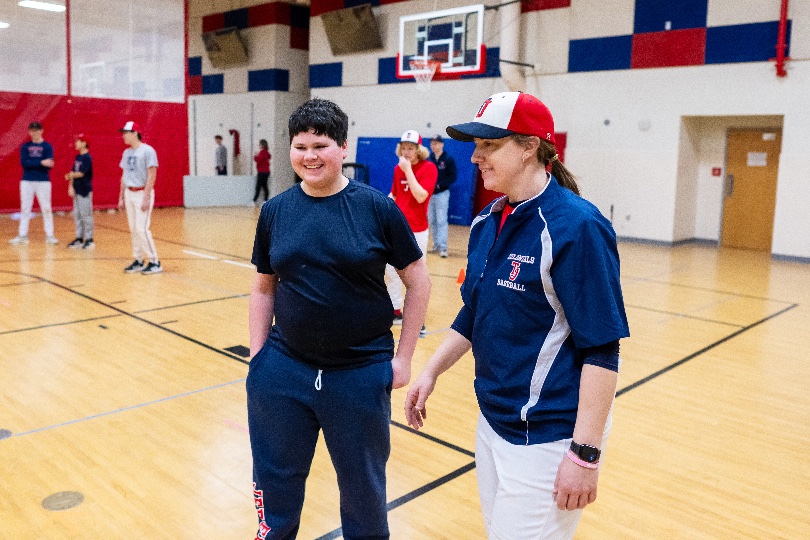
“She throws out a ton of ideas, but this one, I seem to really latch onto,” says the 17-year-old. That’s because his brother, Nick, an eighth grader, has autism, anxiety, attention deficit disorder and learning disabilities that have disrupted his own love of America’s pastime.
Like his older brother, Nick started playing T-ball as a tot. But right before the pandemic, Carolyn noticed Nick was starting to struggle. “They were getting into coach pitch, so it was getting much faster,” she says of the ball speed. “He wasn’t quite there where a lot of his teammates were…so it just stopped for him.”
She looked for adaptive options, but “there just aren’t a lot of adaptive opportunities out there.” Little League has a Challenger Division for players ages 4-22 who have intellectual and developmental disabilities, but not every player can take on weekly practices and games. Arlington County has a Therapeutic Recreation program, but organized sports teams aren’t part of it. Some area middle and high schools participate in the Unified Special Olympics program, an after-school club that teams neurodiverse and neurotypical players. It focuses on basketball, soccer, and track and field, but not baseball.
If You Build It, They Will Come
After the discussion with his mom, Haydon started working to bring an adaptive baseball camp to fruition. He started by getting approval for the idea from Coach Hammond.
“The impression that I got was that this was a very much underserved portion of our community,” Hammond says. “While there are more organized things available, it’s hard to find that introductory camp or those opportunities for these kids to be in a space where there’s not a lot of pressure, there’s not a long-term commitment.” The TJHSST camp was “an opportunity to try something and to be welcomed, regardless of where they’re starting at or what their previous experience was.”
Next, he got the OK from the school’s director of student activities, Leah Conte, and secured funding from the Athletic Booster Club. Then, Haydon worked with Hammond, his mom and the team to determine how the program would look. They opted for the partner approach.
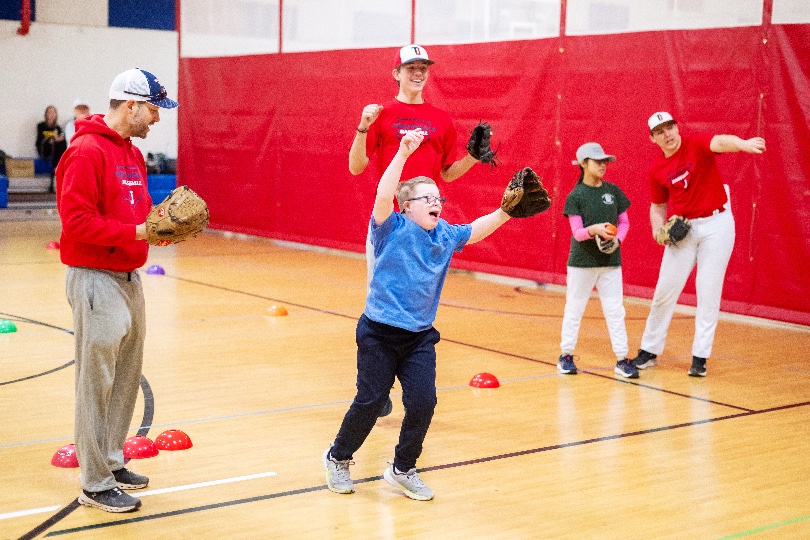
Haydon says that was the best part. During the first clinic, he worked with a little boy named Eric. “I was throwing with him, I was hitting with him, helping him hit,” he says. “I’ve seen my brother missing out on opportunities just because he couldn’t quite participate the way other kids have, so it’s definitely heartwarming.”
Nick was there, too, running a darkened sensory room with fidgets for any campers who needed a break. He also helped with setting up the camps and the session-end games. “He chose his moments and what made him feel comfortable,” says his brother.
Hitting It Out of the Park
Attendees paid $25 per session or $50 for all three, bringing in about $1,200 for the team. But the experience was the real reward.
“At the end of the first camp, several parents stopped me on the way out and said, ‘This was incredible. We’ve never been able to just bring our child somewhere and just sit on the bleachers and watch them,'” Haydon says. “It was just constant smiles, smiles from the campers, from the players.”
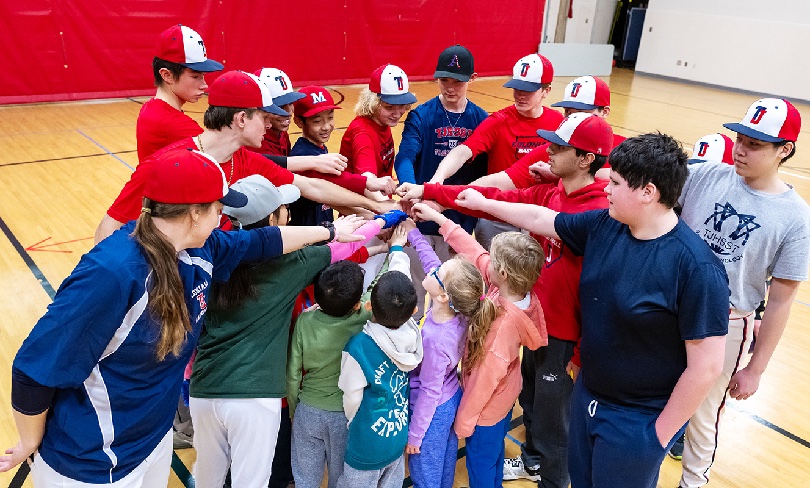
Jacob Wolfstahl, a 16-year-old Arlington resident who plays second base for TJHSST, says he hadn’t worked with kids with special needs before volunteering for the camp. Now, he hopes to do it again.
“Being able to see the individual impact of something like this, watching each individual camper having fun, experiencing the same things that I got to experience when I was a kid, that was definitely important to me,” Wolfstahl says.
Vavredge says her daughter, Lilly, has been in autistic burnout, which Autism Speaks defines as “a state of intense mental and sometimes physical exhaustion and loss of skills needed to manage daily life.”
“The coaches and students ran around with her, lifted her up to throw in a basketball and played tag, meeting her where she was at,” she says. “The staff were amazing with her.”
Loading the Bases
Coach Hammond says interest in hosting another camp was immediate. “There was an email chain [to start planning the next one] less than 24 hours after the clinic ended. We’d like to offer it twice a year, whether we partner with softball and it’s a baseball/softball camp, or whether we see if there’s also interest from other sports and we look at a different sport focus each week.”
Carolyn Haydon says she’s already been in touch with the boosters about more camps. Andrew Haydon has tapped underclassmen players as camp “captains” who can take leadership roles in future programs. “Other sports have apparently reached out about running their own adaptive camps,” he says. “That would be cool to see.”