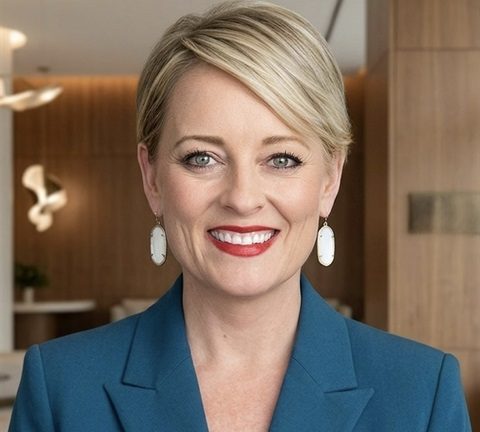
Arlington Economic Development, the county agency focused on business growth, development and tourism, has a new director. Anna Nissinen, who assumed the post in late June, says her focus is helping Arlington build resilience for the future.
Her hiring comes at a pivotal moment as Arlington confronts rapid advances in artificial intelligence, shifting commercial markets and workforce demands for hybrid or remote jobs. These changes are redefining how communities compete for talent and investment.
Nissinen comes to Arlington from the Fairfax County Economic Development Authority. She replaces Ryan Touhill, who served until November, 2025. The following interview has been edited for clarity.
Tell us a little about yourself and your career path.
I’m originally from Finland, where my family instilled in me early on that the future is not something that just kind of happens to you. It’s something we build, and we have a responsibility to build for the next generation. I moved to the United States in my early 20s. My career hasn’t followed a traditional economic development path. I worked in international public diplomacy, doing this work at a national scale for my my country of origin, and then went into local government here in Northern Virginia, across Loudoun County and Fairfax, and now here in Arlington. The central question has always been: How do we, as a community, intentionally shape the future?
What does economic development mean to you?
In my perspective, economic development is not just about creating jobs and attracting investment. It’s larger than that. It’s a system approach to building resiliency and future readiness in the economy. I was excited about this opportunity in Arlington because the breadth of work here is wider than most economic development organizations. It spans not only business investment, business attraction and ecosystem building, but also tourism, placemaking, cultural affairs and the built environment for commercial real estate. I think Arlington is poised to lead that new way of thinking.
What will you focus on first?
I have four main priorities out of the gate that I feel are absolutely necessary now. We are dealing with lots of change, and the pace of change is accelerating. So the first is making sure our community has the talent and skills to succeed in the future—working on that talent pipeline all the way from K-12 to higher education. The second piece is looking at our built environment, the ways of working, the investment flow, and how our built environment has changed in recent years. I commend Arlington’s board and leadership for all the adaptive reuse that is converting aging commercial office space to other uses. The third priority is looking at our quality of place and experience. I’m excited to work with all of our business improvement districts, our chamber, our neighborhood organizations and community partners to figure out how we keep our places vibrant as the world around us is changing. Lastly, we need to be positioned to compete for private sector investment and the creation of high quality jobs.
Speaking of business improvement districts, Amazon’s HQ2 has been indefinitely paused, and Amazon has yet to meet its agreement to bring 25,000 jobs to the area. What still needs to be done?
First of all, Arlington and Northern Virginia winning that project for the region was absolutely transformational, and so that in itself is a huge accomplishment. Obviously the world has changed drastically since 2018 when that happened. The global pandemic changed how we work. Now other geopolitical and economic pressures are changing the the market. I’m looking forward to working with Amazon as well as our community partners to to support them in their next phase. It’s one of my top priorities. I will say that Amazon’s investment in National Landing and the establishment of the National Innovation Quarter created a model for public-private partnerships that’s being replicated.
What is the National Innovation Quarter?
It is a public-private partnership in National Landing where we have Alexandria and Arlington coming together with private sector partners such as SAIC, Northrop Grumman, Amazon, JBG Smith, National Landing BID and others. The partnership just secured nearly $4 million of GO Virginia state grant funding to kickstart it. It’s backed by private sector funding as well. This first-of-its-kind innovation district in Northern Virginia will elevate up-and-coming technologies that are going to define the industries of the future. It’s going to be a changemaker in the Northern Virginia/Washington region.
You mentioned changes brought about by the pandemic. The shift to hybrid work has left Arlington with a significant amount of empty office space and declining tax revenue? How do we fix that?
It’s one of my priorities to look at that built environment and ensure our office space capacity is responsive to market demand. Aging inventory is always problematic. We need to be targeted in our efforts to attract investment that we’ll then realize in tax revenue for the county. We also need to be laser focused on increasing tax revenue from tourism.
Are you targeting specific industries for business growth?
Any industry that will be transformed by emerging technologies, including artificial intelligence and quantum technologies. Also companies working on dual-use technologies for public, private and commercialized use. Space and aerospace commercialization is another one. We’re seeing a lot of high-growth startups in the space sector.
Last year Arlington’s proposed budget included controversial cuts to the gymnastics program and the Cherrydale library. With commercial real estate tax revenues under pressure, how can the county respond to slower revenue growth?
We need to continue using our best economic development tools to attract more investment, which in turn will grow the tax base. We also need to make sure we’re cultivating an ecosystem that is conducive to high-growth startups growing and remaining here, not only in Arlington but the wider region. That is the only way to diversify the economy and the tax base in the current investment environment.
How can Arlington make its commercial areas more resilient?
We are currently undertaking a statewide commercial real estate study. Arlington is leading this as part of the Northern Virginia Economic Development Alliance. The study looks at urban environments like Arlington and Northern Virginia in general, as well as the Greater Richmond area and the Hampton Roads area to see how we reposition commercial real estate to attract the most investment. That study will be ongoing for the next fiscal year, with results coming out next spring. Decisions about how to position our real estate for the future will be data driven.
How will AED help small businesses survive and grow?
Arlington’s small business ecosystem is one of our community’s biggest strengths. There are over 10,000 small businesses in Arlington. They are essential in creating a vibrant urban environment that extends to the cozier corners of the county. We have an incredible team in BizLaunch (the county’s small business support program) that works with small businesses on a daily basis. AED also works with partners like SCORE (a nationwide organization that supports entrepreneurs) and the Arlington Chamber. We understand these businesses are under a lot of economic pressure right now, so this is another high-focus area for me.
Any big picture observations?
Arlington doesn’t succeed alone. We are part of an incredible Northern Virginia region, as well as the Greater Washington region. There’s nothing else like it in the world. Arlington is the tip of the spear.