
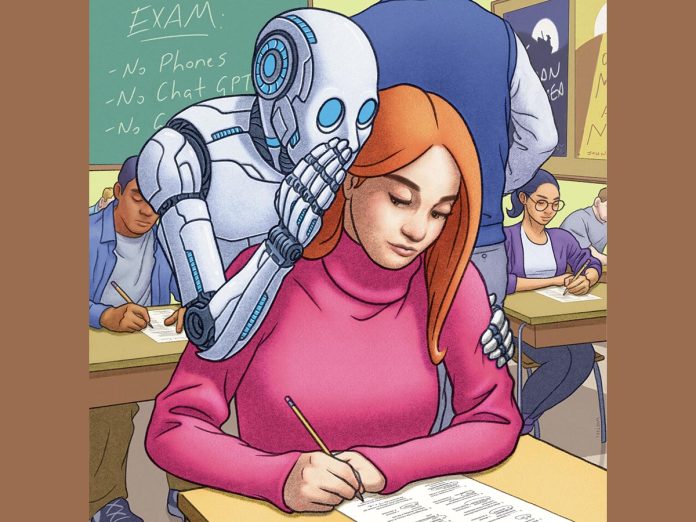
In the spring of his final semester at Washington-Liberty High School, Cory developed a sort of reverse senioritis. He had made it through the pressure cooker of W-L’s International Baccalaureate (IB) program and secured a spot at the University of Virginia after earning straight A’s throughout high school. Like many of his peers, he had some help. With access to ChatGPT and other generative AI tools, he could polish a speech for a class presentation or let the software spit out the answers for low-level assignments and quizzes. Some might call that cheating. He says not using AI would have put him at a competitive disadvantage.
But Cory, who spoke on the condition of using a fake name so he wouldn’t jeopardize his academic standing, says he began to view AI as a crutch, “and it started to freak me out.” He could feel the impulse to ask “Chat,” as he calls it, before formulating his own thoughts. He didn’t like that, so he resolved to stop.
“A couple months out from the end of the year, I started to realize that I’ve done well for myself,” Cory says. “I might as well try to learn.”
For anyone with unrestricted internet access, Pandora’s box comes with a blinking cursor and a prompt. ChatGPT encourages users to “Ask anything.” Google says, “Ask Gemini.” Claude inquires, “How can I help you today?”
Four years into the age of GenAI, we do not just have search engines sending us links related to keywords. We have human-like hiveminds scraping the internet for most everything that’s ever been put online. Capable of delivering detailed answers and carrying on conversations, they appear to comprehend queries, bend to instruction and feedback, and mimic style and tone upon request. And they’re accessible 24/7.
In a February 2026 online survey of nearly 1,500 U.S. teens by the Pew Research Center, 54% said they had used chatbots to help with schoolwork, and one in 10 said they use chatbots for “all or most” assignments. (Given AI’s accelerating rate of adoption, it’s fair to assume usage has only increased in the six months since the study.)
If you are a high school student who is strapped for time, under pressure and building a college resume, you may feel tempted to use AI in a dishonest way. In the right context, teachers may be encouraging you to use the technology as a new tool. Depending on your school, the AI policy may be nonexistent or open to interpretation.
If you want to cheat, you can—and you will likely get away with it, but not without the bare minimum effort to disguise the chatbot’s answers as your own.
Per state guidance, Arlington Public Schools (APS) has adopted a bell-to-bell phone ban, incorporating pouches from a company called Yondr that magnetically seal students’ cellphones for the day. Teens say they can get around the requirement by locking up a dummy phone or lying about leaving their phone in the car.
For a stumped test-taker who is willing to take the risk, sneaking a phone into an exam presents an opportunity to secretly snap a photo of the test, feed it to AI and copy the answers.
The lure of AI is a challenge now facing every school, student, workplace and individual in the dawn of this new age.
At Public Schools in Arlington, McLean and Falls Church, administrators are making an effort to harness AI for good. Over the past two years, area school systems have established evolving standards for teachers and students while adopting—or in some cases, blocking—software that leverages AI tools on school devices.
And yet, teenagers will be teenagers. Two decades before ChatGPT’s 2022 debut, the late Rutgers professor Donald McCabe, widely considered the founding father of research on academic integrity, initiated a years-long survey of over 70,000 U.S. high school students that found more than half admitting to cheating on a test, and 95% confessing to any form of cheating.
Now there are powerful new tools in the arsenal. Anecdotally, AI usage that breaks plagiarism and citation rules is widespread. Some students can’t be bothered to hide it, doing little more than copying and pasting the text spat out by AI into papers and assignments.
“They’re not as sly as they think they are,” says Sean Tracy, a science teacher at Wakefield High School who leads classes in ecology and teaches advanced placement (AP) students how to write college-level research papers.
“I have received papers that have their query as the first line of the paper,” Tracy says, referring to the questions or prompts that students type into a chatbot. He says he’s seen research papers where the last line is a follow-up question clearly written by AI: “Would you like your conclusion to sound more [professional or conversational]?”
“Or, they even come in the exact same format that the queries pop out,” with headers and bullet points, Tracy says. “I teach teachers how to use this stuff. What, do you think I can’t spot this?”
High school students interviewed for this story said they use AI every day for a variety of tasks. How much they lean on it for schoolwork depends on the type of assignment, the teacher who assigned the work and whether their peers are also using it to get a leg up in the class. APS has set guidelines for AI use that some students consider restrictive. Fairfax County Public Schools blocks GenAI tools on students’ devices.
But the definition of what it means to produce one’s own work is changing in real time. The question is no longer, How can AI help you? It is, How much efficiency can you gain? Will you use this revolutionary research tool to dig deeper? Or will you outsource your intellect to the machines?
One APS student, who we’ll call Amy, says she uses AI every day. ChatGPT is the most popular among her friends. She likens it to an advanced Google search.
“Anytime anyone has a question or feels uncertain about something, AI is where you go to get an answer, and it’s an answer you trust where it’s tailored to you,” says Amy, 18, who spoke on the condition of using a fake name so she could disclose how she uses AI at school.
ChatGPT is her go-to for classwork, but she says she avoids asking it personal or emotional questions that would be better suited for a therapist.
Like Cory, Amy is a member of W-L’s Class of 2026, and a graduate of its IB program. A self-described overachiever, she got straight A’s in high school and was admitted to a top public university.
“I struggle when everything isn’t perfect,” she says.
Amy knows that some AI tools will fabricate facts and sources in instances known as hallucinations. Still, she doesn’t know anyone in her class who does not regularly use AI.
According to a year-end report from APS, 89% of the Class of 2026 will pursue education after high school, and students have landed more than $30 million in scholarships. In the competitive Arlington bubble, Amy says, “nobody has shame” about using AI. “Everyone is trying to survive against everyone else.”
As an academic aid, she says AI is most useful as a tool to generate practice questions for exams, which she could accomplish by uploading a study guide provided by her teacher. Under the latest guidelines set by the school district, this is an ideal use, although by the letter of the law, she should have been using an APS-approved platform, SchoolAI, with oversight by her teacher.
Students won’t frequently turn in a whole essay written by AI, Amy says, but they are likely to generate one with prompts, then “go back and use it as an outline.” Half the time, she says, students use it for “the little assignments.” Need to show notes? AI can generate those if you feed it the source material. Need to fill out a Spanish worksheet? You can feed AI the material and copy the answers.
“Homework assignments…are completely useless at this point,” she says.
She always read the assigned books in high school, knowing she’d fail the exam if she didn’t know little details. But she didn’t want to spend her time doing busy work when she knew nobody else was. If an assignment was only worth 5% of the grade, she was fine letting AI do it.
“When the way we are learning is so easily AI-able, you’re holding yourself back [if you don’t use it],” Amy says. “The rest of your class already AI-ed it in five minutes. You’re doing the work for five hours. Now you have so much less time to get your other work done. You have B’s. Your friends have A’s. You have a harder time getting into the college you want. They’re already there.”
It’s not that she doesn’t love to learn. But she doesn’t feel the system of preparing kids for college is set up to prioritize education: “It’s set up for us to compete against each other.”
Cory, who cut down on his AI use at the end of the 2025-2026 school year, says he still consults ChatGPT for everyday issues, like advice on how to treat a harsh sunburn or whether a mechanic is fleecing him.
He considers himself to be on the same page as W-L’s administration. Plagiarism is a clear line. And then there are areas where he fudged it.
When he started IB classes, he was required to give a lot of presentations in front of his peers. Looking back, he says, no one sounded like they were in high school. “Everybody would use AI in the program, and that set the new standard,” he recalls. “If you weren’t using AI and you were just talking in a student-led way, it wouldn’t sound as professional.”
W-L’s IB program allows students to cite generative AI as source material, or to use it as a research tool to find sources. But, like Amy, Cory found that outsourcing to AI became the norm for small assignments. He would use whatever program his school computer would allow. First it was ChatGPT. Then, when that was blocked, Google Gemini. Once he got his college email account, he could use a function in Microsoft Outlook.
The harder his classes got, the more “justifiable” it began to feel. If an assignment felt trivial, it seemed okay to use AI. But, “if there was a huge unit test, there wouldn’t be cheating,” he says.
Though he would never copy and paste from AI, Cory says he would allow it to suggest a thesis statement and search source material for evidence to structure his argument.
“It’s working with AI, but it’s still a lazy way to go,” he says. “I think that’s what most people would do. It would be their own words, but it would be based on what AI would be telling them.”
He committed other infractions, using old and new tech that had nothing to do with AI. He always read an assigned book, he says, but would occasionally skip chapters or read a summary from a SparkNotes study guide (very Millennial).
He remembers one instance, in a biology class, where a group of students created a shared document, and someone in an early class uploaded a photo of a test so a later group could find the answers.
“I would do what it takes,” Cory says. “If that meant using AI or looking at a doc with answers to a test, I think that pressure did supersede the idea that I was just here to learn.”
For the past two years, Arlington schools have been methodically preparing—and shifting in real time—the guardrails for generative AI. Under the Virginia Department of Education, APS has a grade-by-grade imperative to create good digital citizens, meaning “students recognize the rights, responsibilities, and opportunities of living, learning, and working in an interconnected digital world, and they act in ways that are safe, legal, and ethical.”
Early in 2024, a little more than a year after OpenAI released ChatGPT to the public, APS launched a Year of Exploration, a multiphase plan to integrate the technology. An AI governance committee formed. Staff training took shape. A pilot program empowered 400 volunteer teachers and administrators to try AI tools and provide feedback that informed decisions on what technology the school system would adopt.
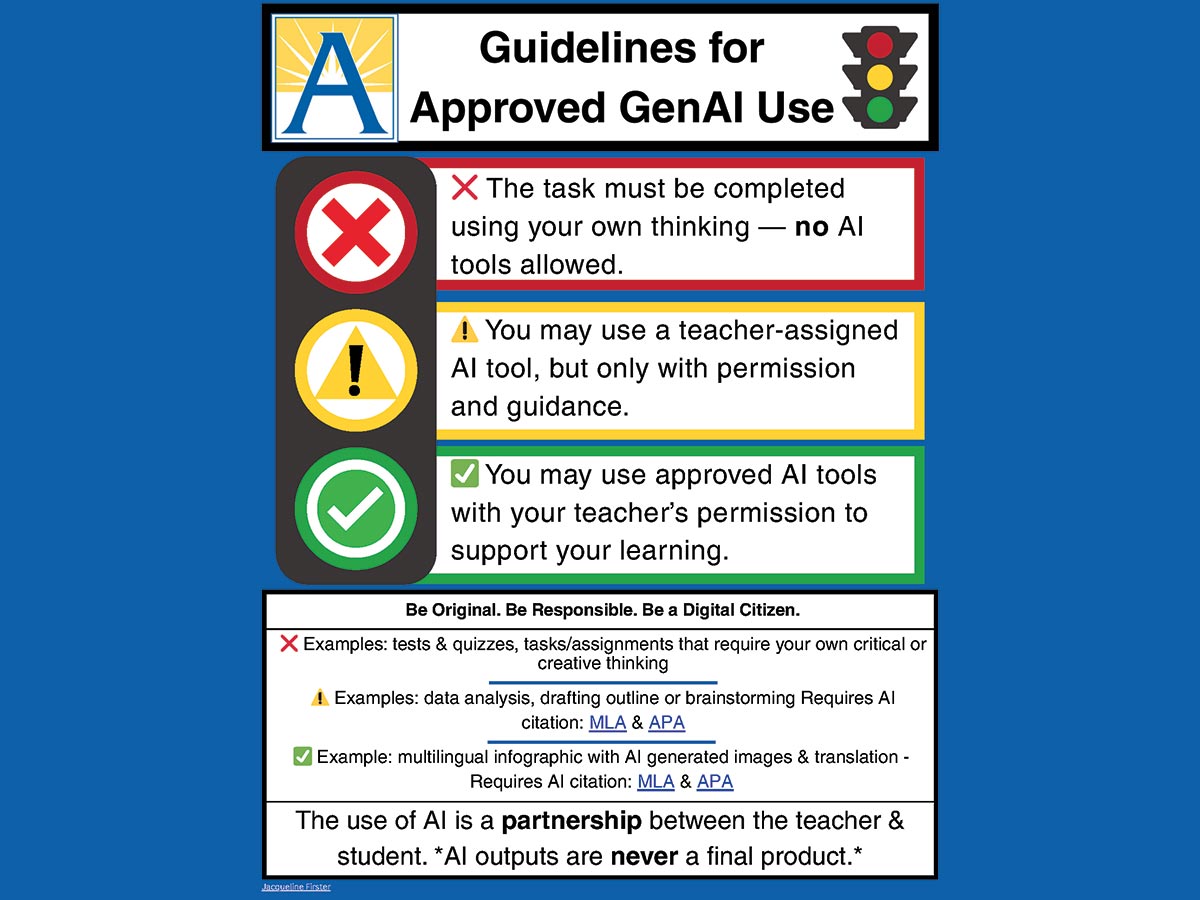
“Our goal is not to eliminate AI,” says Jacqueline Firster, Supervisor of Digital Learning & Innovation for APS. “It’s to help our students understand how to use it appropriately and when not to use it. It’s to increase AI literacy skills.”
By the 2025-26 school year, APS had begun a Year of AI Empowered Learning. Three posters, shared online, detailed scenarios in which students should not use AI at all—for instance, while answering questions on a test or a quiz, or completing an assignment where you’re supposed to use your own critical thinking skills—as well as when they could consult a tool with a teacher’s approval or when they could incorporate AI-generated content, with the proper citation. “Use Your Own Voice!” one poster implored, reminding students that “YOU are in charge!”
Last fall, the school district designated three generative AI tools as approved. Faculty could use Microsoft Copilot and Google Gemini. Staff and students could collaborate in SchoolAI,
which allowed teachers to monitor students’ conversations with a chatbot and analyze how well they understand certain topics.
Tracy, the Wakefield science teacher, says he’s used AI to generate practice questions for students who need an assist on their Standards of Learning (SOL) exams. Or, he can feed the chatbot a news article and have it develop a quiz on a topic he may have heard about on the way into work, like the sewage spill in the Potomac. (The quiz needs editing, of course.)
“It’s not something that I would ever just pop off to the students,” Tracy says. “But it is helpful in getting me a summary of this long article that I just kind of saw and skimmed. It helps me figure out where the hot points are.”
In April, APS held a town hall on AI in education, inviting a few high school students onto a panel led by superintendent Francisco Durán that also included local leaders in business and education.
“I have seen many school systems across the country ban AI altogether and say we should not [have] it,” Durán said onstage, “and I’ve seen some school systems have no guardrails or conversation policies at all, and we don’t want either of those. I think there’s a happy medium that we need to find. It’s our duty to do that because we do know artificial intelligence is not going anywhere, and we are preparing our students for the future.”
The first student Durán invited to speak was Damon Maher, then a senior at Yorktown, who talked about how he was using AI to study for AP classes and in his internship at a wealth management firm in Tysons. Maher demonstrated the product feature in Claude, showing the audience how he had it execute sophisticated tasks by uploading documents it could use for instruction.
In a subsequent interview with this magazine, Maher, who heads to UVA this fall as an Echols Scholar, said he felt most of his classmates were not taking advantage of AI’s full potential. “They were treating it more like Google.”
Although he finished high school during APS’ Year of AI Empowered Learning, he says the message to students at Yorktown was clearly different: Don’t use it.
“It was kind of just the absolutist policy of no polishing, no editing whatsoever. If there’s any AI use at all, it’s a 0,” Maher recalls.
That didn’t deter students from consulting it anyway, he says. If you looked around a class of 24 people, you’d see five to 10 students with an AI tool open on their laptop screen, “maybe in an ethical way, maybe not in an ethical way.”
Maher says he was always wary of using AI-generated writing, because he didn’t want to lose his voice. But he did use the technology in other ways, whether that was feeding it vast amounts of class material to consolidate into a digestible study guide, as a writing coach for college essays, or to game out the math portion of SAT prep with time-saving shortcuts.
He’s heard other students justify the use of AI for assignments they don’t consider worth their time—“If it’s just a lazy assignment from the teacher, that’s just busy work.” Or if they got stuck on a difficult section “and then end up using it for the whole thing.”
Public schools’ response to the technology should be taken with a lot of grace, he says, because administrators need time to understand it and create policies. He understands why some tools are blocked, but notes that his peers have found a way to unlock the tools on their school laptops anyway. Or sneak their phones into class.
“It’s just a constant arms race between students and teachers,” he says. “It’s been that way since ever they got iPads in elementary school and APS wanted to block them from playing online games. People always find a way.”
Student cheating isn’t a new phenomenon. Examples of academic dishonesty have been recorded as far back as ancient China. In the old days of basic web browsers, Tracy, the Wakefield science teacher, remembers getting papers turned in that failed to hide links back to Wikipedia. Generative AI may have opened new channels, but it’s debatable—statistically, at least—whether cheating is on the rise.
In February, researchers at Stanford University and the nonprofit Challenge Success published a study in Educational Technology Research and Development that examined whether the advent of AI chatbots affected the prevalence of academic dishonesty in high schools.
The research, based on anonymous surveys given to more than 4,000 students at a mix of public, private and charter schools across four months in 2024, found 72% of students reporting that they had engaged in at least one academically dishonest behavior in the previous month. This was in line with statistical findings from studies and surveys completed long before the release of AI.
The Stanford study also had 83% of high schoolers saying AI should “never” be allowed to complete entire assignments or write papers. The most common use of AI chatbots, according to 82% of students, was to help explain concepts, problems or topics.
During the recent APS town hall on AI, Richard Culatta, CEO of the International Society for Technology and Education, cited the Stanford study as evidence that any supposed correlation between AI and cheating is merely “noise.”
“The number one determining factor of whether or not there is cheating in a school is how relevant the assignments feel,” Culatta said. “If students feel like the assignments they’re getting are not relevant, cheating goes up.”
In a bit of irony, the technology heralding a new era of efficiency is prompting some teachers to focus more heavily on a human touch. AI can make it difficult to tell whether a student’s words are their own, so savvy educators are finding ways to establish a baseline voice, tone and vocab for each student.
In Tracy’s AP classes at Wakefield, he kicks off the semester by having students handwrite a short essay on a simple prompt—say, their opinion on what the legal driving age should be. “I know that their polished, edited paper is going to be a little bit different,” he says, “but at least I have an idea of where their writing skills are.”
That way, if a subsequent writing assignment contains flowery language and long, run-on sentences without much substance, he can go to the student and credibly ask: “Why doesn’t this sound like you?”
AI-checking technology designed for teachers is far from foolproof. Tracy describes false positives and murky scenarios, like when a detector program flagged 100% plagiarism for a student who had written a paper in his native language and run it through Google Translate to convert it to English.
Tracy views all technology, not just AI, as a major distraction for students. That includes phones and laptops. “Next year I’m going to have a real rule about you coming in and you pull out a pen and pencil and you don’t open any device until I tell you,” he says. He acknowledges he’ll need to train himself first.
Philip Krauth, an English teacher at W-L since 1997, has developed a reputation as one of the most engaging teachers in the school. He says he’s famous—“maybe infamous”—for his section on Dostoevsky’s Crime and Punishment. Students identify with the protagonist’s philosophical shift from romantic idealism to harsh realism.
Krauth says that by pushing students to dig deep and answer thematic questions about the material, he’s showing them just how much there is to uncover within a text. In that way, he still finds the 19th-century Russian novelist’s prose to be fresh and relevant.
“Think about discovering something on your own. It’s a feeling you can’t get from anything else,” he says. “If you’re going to fake it and then try to present that to the class, the class is going to know it’s BS, because it’s evident you didn’t go through the work.”
In his class, he highlights the platitudes and common criticisms surrounding the literature at hand, so students know they can’t use tired arguments. He says 20% to 30% of the work he evaluates from students, especially written papers, “hints at or smacks of some sort of AI help.” If he spots passages that reek of AI, “I might not call them out on it directly, but I will go to town with comments.”
The same goes for public speaking. If a student’s presentation sounds canned, their grade is going to suffer. “I teach them the best presentations aren’t just reading a script or reading off slides.”
As a teaching tool, Krauth uses school-approved AI software to generate slideshow videos that explain how a sample paper succeeds, or to reinforce his rules for writing. He can upload a grading rubric and the comments he most frequently gives to students, letting technology do a lot of the grunt work on writing assessments before tailoring his answers.
The best way to get students excited, he says, is pushing them to make a personal connection to the material and then refer back to conclusions that emerged from in-class discussions.
For the final assessment of a text, students have to propose a project. He encourages them to go beyond a written essay—perhaps adapting part of the novel as a one-act play or turning another section into a piece of music. Recently, one of his pupils compared The Stranger by Albert Camus to the Taylor Swift album “Folklore.”
“They really personalize it,” Krauth says. “Some of these projects blow my mind.”
The world is at an inflection point. AI can supercharge human potential or fully replace it. There are environmental costs and fears about what it means for the value of an education, the viability of entry-level work and the very definition of reading and writing. But one thing AI cannot do is give you a personality.
Gabe Hiatt is a writer and editor based in Washington, D.C. who has led teams of reporters for Eater and The Washington Post.