
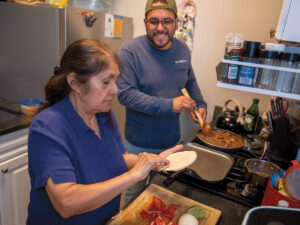
For the past few years, Domingo Lopez has been covering half the rent on his mom’s apartment near Columbia Pike. Rosa Lopez, a former nanny and dishwasher, has been struggling to make ends meet ever since health issues made it too difficult for her to work.
Domingo lives in the same building as his 68-year-old mother, which makes it easier to care for her when he gets home from shifts as a maintenance worker. He moved to Arlington for a job several years ago and enjoys the area for its walkability, parks and restaurants. But lately, it’s gotten harder to stay.
“It’s definitely tough, especially now,” he says.
Domingo, 38, earns about $3,500 a month. Of that, $1,800 covers the monthly lease on his own one-bedroom apartment. He kicks in another $700 per month for his mom’s tiny studio unit. But their rent increases by about 5-10% every year.
He comparison shops for the cheapest groceries he can find but says buying food at his go-to—an Alexandria Walmart—costs almost twice as much as it used to. To scrape together the money he needs to pay the bills, Domingo tacks weekend Lyft shifts onto his full-time schedule. Sometimes he fixes up furniture he finds near dumpsters and sells it online. Lately, he’s been picking up free groceries for his mom at the Arlington Food Assistance Center (AFAC), the county’s local food pantry.
He’s not the only Arlingtonian struggling to make ends meet despite holding down multiple jobs. Rent, childcare, medical, food and gas costs are rising. The pressures on lower-income families have grown worse amid a confluence of economic forces—insufficient housing supply, federal cuts to social services, persistent inflation worsened by the war in Iran.
“It’s kind of a mess,” Domingo says. “We feel it. And we see it, too, in prices.”
Arlington is one of the least affordable places to live in America, with an area median income of $166,100 for a family of four. Residents at all levels of the income spectrum are feeling the impact, but low-income residents have been hit the hardest.
Housing costs pose a significant strain. The U.S. Department of Housing and Urban Development defines households as “housing cost-burdened” if they spend more than 30% of their gross monthly income on housing. Some 40% of renters in Arlington fall into that category, according to an analysis by Housing&, an advocacy group focused on the production and preservation of affordable housing.
About four years ago, Shelly Bailey, 43, moved from a pricier building in Shirlington to a nearby affordable housing community. In September, she was supporting her two daughters, ages 10 and 17, on a $15-per-hour job as a line cook at a local restaurant, with plans to start a second job as a full-time prep cook at Dulles International Airport, making $20 an hour with benefits.
Bailey says she’s used to working 16-hour days. She sleeps about two to three hours a night, once she’s had the chance to care for her kids, eat something and get ready for bed.
“It is hard, so you have to have two jobs to make ends meet,” she says. “But other than that, it’s great living here.”
Bailey pays $1,814 a month for her two-bedroom apartment, an amount that represents almost her entire take-home pay from the line cook position, and about a third of what she’ll be making once she’s holding down two jobs. She keeps a tight budget. A car is too expensive, so her family takes the bus. She can’t afford health insurance, so for now, she doesn’t have it. Sometimes, when unanticipated expenses pop up, she postpones paying her utility bills until they are past due.
Arlington is the fifth-most expensive large city for renters in the U.S., with a median rent of $2,612, according to the real estate website Apartment List. In July, the county’s average home price was $1.012 million.
Land costs are partly to blame (Arlington’s relatively small footprint, transit-oriented infrastructure and proximity to D.C. command top dollar), but housing has also become more expensive to build nationwide as the costs of materials, labor and regulatory hurdles drive up sticker prices. A 2026 survey by the National Association of Home Builders/Wells Fargo Housing Market Index found builders reporting a 6.7% year-over-year increase in the price of building materials, driven by tariffs and inflation.
“The market has gotten so hot that we’re really having to create new housing that is committed [affordable] for the long term and preserve what’s already committed because everything else is gentrifying,” says Alice Hogan, director of the Arlington branch of the Northern Virginia Affordable Housing Alliance. “Everything’s at risk for redevelopment, especially anywhere near transit.”
To qualify for affordable housing in Arlington, a household must earn 80% or less of the area median income. That’s a cap of roughly $133,000 per year for a family of four. The 7.4% of county residents living below the poverty line don’t even come close to that. Neither do many middle-class workers holding down full-time jobs.
Arlington County has nearly 12,000 committed affordable units (homes that lock in subsidized rates for decades) and counted another 5,640 market-rate affordable units in 2025. But that inventory isn’t enough to meet current needs.
“The folks who run our community, who we all rely on, can’t stay here,” Hogan says. “They’re living further and further away. It’s gotten to a point now where it’s not just hourly workers.” School staff, flight attendants, first responders and scores of other workers are feeling the pinch.
Childcare is another big-ticket item for families with young kids. Arlington has the highest childcare costs in the nation, with parents shelling out an estimated $147,000 per child for five years of early childhood care, according to a 2025 Wall Street Journal report. (To arrive at its findings, the Journal crunched Labor Department data to aggregate the cost of one year of infant care, two years of toddler care and two years of preschool in each metro area.) Steep real estate prices are contributing to the sticker shock, as area childcare centers and preschools shoulder burdensome commercial leases.
For cash-strapped families, kid care becomes a math equation. Some parents opt out of the workforce when the cost of sitters, preschool and after-school care exceeds their take-home pay. But the loss of household income may impact their family’s ability to cover other expenses. The Arlington Community Foundation in a 2024 report identified this phenomenon as one of a handful of factors contributing to the displacement of low-income county residents. Some of those residents are childcare workers themselves.
“Low-income residents are being priced out of the community,” the report states. “Among those most at risk of displacement are residents who provide essential services—child and health care, hospitality, office cleaning, and restaurant, retail, and construction work. They are struggling every day to make ends meet, often working multiple jobs.”

Medical costs are further straining household budgets. In a 2026 Gallup survey, health care ranked fourth—behind general cost of living/inflation, housing and energy prices—among the most pressing financial problems affecting families across the U.S.
Some 5.5% of Arlingtonians under 65 (the age at which Medicare eligibility begins) are uninsured, according to U.S. Census data. That’s nearly 12,000 county residents. Arlington has a network of free and discounted clinics that help to fill the gap, but their capacity is limited.
Last fiscal year, the Arlington Free Clinic treated 1,763 patients, logging a 10% increase over the prior year. CEO Lesley Daigle says the clinic is bracing for even greater demand in the wake of Medicaid changes that went into effect Oct. 1. The federal government’s new policy ties eligibility to immigration status, ending coverage for adults in several classifications, including refugees and asylees. On Jan. 1, 2027, new work requirements begin for Medicaid recipients.
“It’s going to be very tough. We’re already seeing people literally come to us like an ER who are very, very sick and need a medical home, and don’t have one,” Daigle says. “[These patients] previously had insurance.”
Carly (not her real name), 57, is a single mom living near Courthouse who works as a special needs caregiver, earning $16 per hour. She relies on Medicaid to cover medical expenses for her own 11-year-old son, who has Down syndrome and struggles with sleep apnea, asthma, seizures and other health issues. To qualify for the federal insurance program, she has to limit her work hours to stay within the program’s income eligibility limits. (Safety net programs refer to this Catch-22 scenario as a “benefit cliff,” where assistance cuts off sharply, rather than tapering, once a participant hits the income ceiling.)
Carly could pick up more hours, but doing so would take Medicaid off the table, requiring her to seek out other insurance options and pay for evening care for her son while she’s at work.
“It’s very difficult…to support my son and make sure my son has the support he needs,” she says. “I only can work a certain amount of hours. You need to choose between one thing or the other.”
To offset food expenses, Carly picks up groceries weekly from AFAC. She’s not alone. The nonprofit has seen a 91% increase in visits to its food pantry since 2020.
One in 10 Arlington adults has an AFAC referral, according to Lily Duran, AFAC’s chief of member services. She attributes the surge, in large part, to post-covid inflation hitting the grocery aisle. “I think inflation is the biggest one—the sheer price of food,” she says. “People who could make it work a couple years ago cannot make it work now.”
Earlier this year, Arlington Thrive, which provides emergency financial services and wraparound support to county residents, launched a baby supply pantry offering free diapers, wipes and other essentials to parents with young children.
“Rent is really expensive, but it’s beyond rent. It’s the food bill. It’s the gas bill. It’s the childcare bill,” says Thrive Executive Director Melanie Anderson, noting that demand has been high since the supply pantry opened. “That really just shows you those essentials are out of reach for so many families.”
Lisa, a resident of Halls Hill/Highview Park who asked not to use her real name for privacy reasons, pairs groceries from AFAC with her SNAP (Supplemental Nutrition Assistance Program) benefits to keep her fridge stocked. The 72-year-old retired medical researcher stopped working during the pandemic to avoid putting her aging family members at risk.
Today, she survives on a $1,403 per month Social Security check, plus whatever she can make participating in medical studies and selling household items she no longer needs.
Although the mortgage on her Arlington home is paid off, her other expenses add up. Lisa has health insurance through Medicare, but her copay is $45 per visit. Gas for her 20-year-old car costs about $200 a month. She tries to set aside another $100 per month for unexpected auto maintenance, but that’s getting harder to do as the annual property taxes on her home approach $9,000.
“It’s a struggle. From month to month, I’m always praying that I don’t have [my] car break down,” she says.
She has no intention of leaving Arlington. Previous jobs took her to other parts of the country, but her family has called Halls Hill home for generations. As an older person, she says it’s critical to be in a place that’s familiar.
“When you go to work somewhere in another state, you have an automatic community built in because you work with people. When you retire, you don’t have that,” she explains. “I need to stay in this community because, number one, I know where everything is. I know people. I know organizations. I know who’s at the county. Everything is here.”
A chronic, unsolved affordability crisis could have shuddering consequences for Arlington in the long run. Commercial tax revenues that pay for schools and essential services could fall if more companies leave town for markets where office space is cheaper and the cost of living for employees is lower.
An exodus of service workers could close restaurants and other small businesses, hurting the visitor economy that brought $4.62 billion in tourism dollars to Arlington in 2025 and yielded $176 million in local tax revenue.
Working parents unable to make ends meet may relocate, hoping to break the cycle of poverty and give their kids a shot at the upward mobility they never had.
Some may not be able to leave. “My biggest fear is that we’ll see families sleeping in their cars and sleeping on the streets,” says Fraser Murdoch, CEO of Bridges to Independence, a nonprofit that provides emergency shelter, rehousing and wraparound services for Arlington families and young adults. “Most people don’t even know there are children who are homeless in Arlington because you don’t see them.”
Arlington’s safety net of nonprofits, mutual aid groups, faith-based organizations and county programs is continually seeking creative new ways to stave off worst-case scenarios for struggling families. But the current economic conditions are bleak.

In fiscal year 2025, Arlington’s Department of Human Services provided more than 1,500 households with emergency financial assistance and eviction prevention, and supported 1,680 households with housing grants, according to county spokesperson Destiny Esper. In October, the housing grant program shifted to a lottery system with a waitlist.
“There is no silver bullet, frankly,” says Brian Marroquin, grants and initiatives director for the Arlington Community Foundation.
In 2019, ACF launched a Shared Prosperity initiative to support low-income residents and prevent their displacement through targeted fundraising, policy proposals and advocacy around affordable housing, living wage jobs and childcare costs.
As housing costs gobble up larger and larger shares of workers’ take-home pay, nonprofit developers such as Affordable Homes & Communities (AHC) are seeking innovative ways to construct more homes for the county’s lower-income residents.
Some projects are holistic in nature, addressing more than the housing piece of the puzzle. One of AHC’s current endeavors is a 128-unit residential complex on the site of the Glebe Road Goodwill. Upon its completion, the structure will contain retail space for the secondhand store on the ground floor, as well as on-site, subsidized childcare for building residents.
“How do you provide for greater economic mobility? If we can get people not paying any more than 30% of their income for housing, that means 70% can go to other things, like investing in [education and job training] to grow and to be mobile economically,” says AHC CEO Paul Bernard.
Arlington County officials are aiming for 17.7% of Arlington’s housing stock to be affordable by 2040. The current share is 12.8%.
Working mom Shelly Bailey hopes she can someday afford to buy a house. Her family has lived in the D.C. area for four generations, and she’d like to stay close to home.
For now, she’s figuring out how her older daughter, a high school senior, will pay for community college. She’s trying to scrape up the funds to buy her a prom dress next spring.
At one time, Bailey says, all the financial pressures and concerns were a major source of anxiety.
“It used to worry me, but it doesn’t worry me anymore,” she says. “I had to learn that. If I worry and get sick, who’s going to take care of my kids?”
Eliza Tebo is an Arlington-based freelance writer, podcast host, teacher and musician. She wrote about the nonprofits that make up Arlington’s social safety net in the November/December 2025 issue.