
Among the busy suburban moms, alcohol is a release. They gather over drinks in living rooms, on front porches, at school auctions and charity events. They cook and vacation together, opening bottles and spilling their feelings about parenthood, work stress and everyday life. The dads drink, too, of course, but the women have been labeled “wine moms.” Some have the decorative pillows to prove it.
For Carrie, who asked not to use her real name for professional reasons, it all began to feel like too much time at the club—the book club.
“It just turns into a big party scene,” says Carrie, who owns a small business in Arlington.
Carrie knew she needed to step back, but she still wanted to take the edge off. Then, two things happened: She began taking GLP-1 drugs to manage her weight, and she discovered edible cannabis. She no longer felt a physical desire to drink. And it had never been easier to find gummies.
An occasional weed smoker, Carrie says she took to edibles during a trip to New York with a girlfriend and realized she preferred the “buzz” of cannabis over alcohol. It helped her focus. After averaging two hangovers a week for two decades, she loved waking up without a headache, nausea or the sinking feeling of regret. And if she needed to perform a menial task like cleaning the garage, weed ensured she’d crush it with a smile.
“I’ve never done anything that I’ve regretted when I’m stoned, but I’ve done stuff I’ve regretted on alcohol,” Carrie says. “Anybody who drinks regularly has woken up like, ‘What did I just say? What did I do last night?’”
Attitudes about alcohol and cannabis are shifting in the U.S., and Northern Virginia is no exception.
In a Gallup poll last year, 54% of Americans said they drink alcohol, the lowest number in the history of a survey that has been conducted since 1939. (Peak consumption occurred from 1976 to 1978, when 71% of respondents said they were inclined to partake.)
A 2025 advisory from the U.S. Surgeon General identified alcohol as a leading preventable cause of cancer, responsible for 20,000 deaths nationwide per year.
Meanwhile, marijuana has gone mainstream. Popping a gummy or sipping a THC seltzer has taken away the skunky scent—and some of the stigma—of getting high, with the added benefit of bypassing the lungs.
In hindsight, Carrie says the decision to cut back on drinking and lean into cannabis feels like a no-brainer. A daily dose, sometimes smoked out of one-hitter but more often consumed as a gummy, helps her unwind. It allows her to unplug from a news cycle that feels relentlessly depressing. “With all the crazy stuff that’s going on, sometimes I feel like I’m slipping into another dimension,” she says.
In a metro area populated by policy wonks, government workers and hard-driving entrepreneurs, cannabis stories often follow a familiar arc. People who experimented with weed as young adults, then abstained for years or decades, are now rediscovering it for medical or recreational use.
Many dabbled in college, but it became taboo as they applied for jobs requiring drug testing or security clearances. Years later, maybe a friend encouraged them to take a hit or try an edible to soothe their sore muscles and troubled minds. The rules were different. While still illegal under federal law, cannabis is now permitted in 24 states and Washington, D.C.
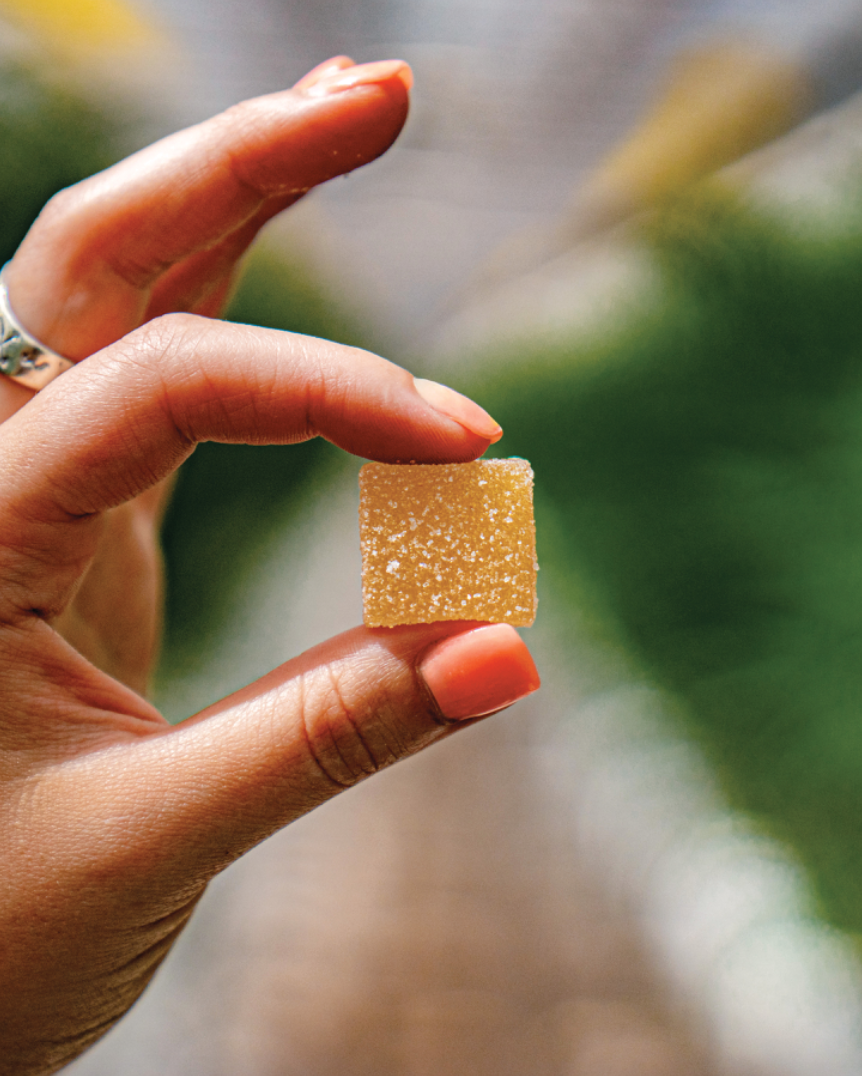
Jenni Hogan, 40, an Arlington mom and small business owner, has a medical license and uses weed as an alternative to alcohol to help her relax.
The first time she got high was in high school. She says she used cannabis recreationally on and off for years but stopped when her two children were very young. She’s recently become a more regular user. This year she observed “High January,” abstaining from alcohol, but enjoying the occasional gummy.
During the pandemic, Hogan felt her relationship with alcohol was getting unhealthy. She’d have a glass or two of wine or beer every other night, and at least one night of heavy drinking per week.
“I found that having a little bit of a gummy helps to give me that same sense of calm,” she says, “but not lose any sort of control or feel like I couldn’t function.”
She says her kids, now 8 and 10, know that her gummies are for grown-ups, and she keeps them locked away. According to public health data published in The New York Times, poison control centers reported 22,000 cannabis-related incidents in 2024, with more than 75% involving children or teenagers.
Whether she’s drinking or using cannabis, Hogan practices moderation. She says it’s important that her kids can never tell she’s impaired. But they have seen her take edibles. She emphasizes that it’s a legal, prescribed product, no different than enjoying a glass of wine.
“I tend to be very open about my usage,” she says. “I’m a single mom. I’m taking care of my kids. This is still a choice that I’m making. I’m a responsible business owner. It’s a decision I’m not ashamed about.”
Jane, a therapist from South Arlington who asked not to use her real name for professional reasons, has followed a similar path back to pot. Her first introduction to it was during her student years at a small liberal arts college, when her friends would sometimes pack a bowl for the group.
A few years ago, she and her husband started hanging out with a couple who liked to smoke weed. One day their friends came by with THC-infused drops that could be used to mix drinks.
Jane says it’s been about two years since she decided to go “California sober”—cannabis, but no alcohol. She made the lifestyle change as more data became available about the health risks of drinking. Her family has a history of cancer.
Cannabis comes with its own health risks. The Centers for Disease Control and Prevention warns that physical dependency on the drug is on the rise, and some research suggests that it may heighten the risk of stroke and heart disease. Other studies have linked marijuana use to poor classroom performance among children and teens and warned of its negative effects on developing brains.
For Jane, edibles have helped stop a pattern of drinking that began during the pandemic. At first, she and friends would make cocktails together over Zoom. Then they’d have beers outside while standing 10 feet apart and watching their kids play. She found herself socializing with other parents so much she felt like she was back in her 20s.
“It was a way of coping. It made things seem fun,” she says. “Once covid started to subside, the behavior definitely didn’t subside.”
If you want to get high in Virginia, there are legal and quasi-legal ways to obtain marijuana. Since July 2021, state law has allowed Virginia residents 21 and older to possess and grow their own pot. Medical dispensaries are legal. Recreational sales, also known as adult-use, are not.
But there are loopholes within the 2018 Farm Bill, which lifted restrictions on the cultivation and interstate commerce of hemp, a plant species similar to marijuana. Retailers and restaurants may sell any plant-derived product that contains less than 0.3% of Delta-9 tetrahydrocannabinol (THC). Non-intoxicating cannabidiol (CBD) is a legal hemp product. So is a seltzer or gummy containing a low ratio of psychoactive THC to weight. (For example, a product with a CBD-to-THC ratio of 10:1 or 20:1.)
Wherever there’s a tobacco and vape shop, you’ll find other forms of THC, including Delta-8, THC-A and THC-P, all of which are technically legal through the Farm Bill—at least until November, when a more restrictive law is scheduled to take effect.
For now, Carrie purchases THC seltzers online from Cycling Frog, a cannabis company based in Seattle.
Jane orders gummies from Austin-based Earlybird. She says Instagram has gotten wise, flooding her feed with ads for edibles. (After I started researching brands for this story, I saw Cycling Frog pedaling through my Instagram Stories, too.)
“My algorithm knows I don’t drink anymore,” Jane says, “and now it’s like, how about this?”
Some Virginians skip mail-order and drive to Maryland, where adult-use dispensaries are legal, or into D.C., where illegal “gift shops” still operate as a holdover from the city’s murky Initiative 71 era. (The gift shops sell items such as stickers and t-shirts at a significant mark-up, providing cannabis products as a complimentary “gift.” ) Medical dispensaries in the District are accessible to patients who go through a breezy self-certification process online; non-residents can apply for a 90-day registration or show eligibility through a license from their state.
In January alone, the state of Maryland recorded $554 million in total adult-use sales, including nearly $9 million in edibles, according to the Maryland Cannabis Administration.
Arlington’s only medical dispensary is on Wilson Boulevard in Clarendon, across the street from Whole Foods. It occupies a nondescript black building with the name, Beyond Hello, spelled out in big white letters above the front door. This is where Hogan buys her gummies.
Inside, an airy waiting area features a plush sofa, leather-cushioned chairs and a staffed front desk. Visitors of legal age can scan QR codes to initiate the process of signing up for a telemedicine appointment to obtain a medical license.
Customers who already have a medical marijuana license can browse a sales floor decorated with blond wood and abstract paintings with cool jazz playing in the background. The vibe isn’t unlike the lobby of a luxury high-rise building or a cafe that sells geometric flowerpots for succulents.
I arrive at the dispensary for a tour as soon as it opens on a Saturday morning. Within 15 minutes, I’ve counted four customers.
“You’d be surprised at how many soccer moms or elderly folks are coming in here, whether that’s for chronic pain or looking for opportunities for helping them sleep,” says Trent Woloveck, chief strategy director for Jushi, the national parent company of Beyond Hello.
Pristine glass cases display every kind of cannabis product imaginable. Turned off by smoking? In addition to flower (the harvested, dried buds of the cannabis plant), prerolls and vapes, there are THC edibles, tinctures and balms.
Most of the products are Jushi brands delivered from the company’s processing and cultivation facility in Manassas. Notable exceptions include Dogwalkers, a line of short, stubby joints from market giant Green Thumb Industries, and Rise and Rest gummies from Shayo, the Virginia cannabis company owned by Real Housewives of Potomac star Stacey Rusch. In one display case, the Shayo gummies are staged next to a sage smudge stick.
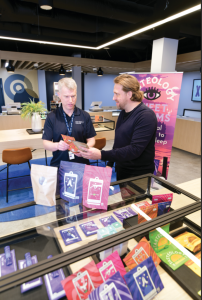
Store manager Ryan Milliken is the PIC—the pharmacist in charge. He’s wearing a polo shirt, gray slacks and dad shoes, and reminds me of Ken Jennings from Jeopardy! He doesn’t look like he ever says the word “dank.”
The term “budtender” is out of fashion, Milliken says, explaining that his role is more complex than simply steering people toward indica or sativa, the two main types of cannabis. Indica is distinguished by a sleepy, body high (aka “in da couch”) while sativa produces more of a heady, euphoric buzz. But today’s products aren’t necessarily one or the other. There are complex hybrids promising varying therapeutic effects. Milliken’s job is to help customers find the right match.
Because every product is tested in a state lab, he knows the percentage of chemical compounds called terpenes in each one. He may steer a customer in need of a sleep aid toward a product with a higher percentage of myrcene, whereas someone seeking anti-inflammatory properties might benefit from one containing beta-caryophyllene.
As the PIC, Milliken also cautions patients about potentially harmful interactions with medicines they may already be taking. CBD shouldn’t be used in combination with the statin family of cholesterol drugs, he says. Some blood thinners should not be used with cannabis.
Beyond Hello fulfills its orders in a pharmacy behind a locked door to the showroom. Wire metal racks hold rows of stocked trays, each tagged with barcode identifying its place in the Virginia Cannabis Control Authority’s seed-to-sale tracking system. The room is clinical in appearance, yet unmistakably pungent.
Woloveck says Fridays are always busy at the dispensary because it’s payday and the start of the weekend. As holidays go, he adds, “Thanksgiving has become bigger than 4/20,” the unofficial national holiday for stoners.
According to data from the Virginia CCA, total sales of medical cannabis eclipsed $13 million every month from September 2025 through February 2026. In February, flower accounted for 41% of sales, with concentrates representing a close second, and infused edibles coming in at 17%.
At one point a notification pings Woloveck’s phone, and I see his screen light up. The background is a cartoon of Mr. Monopoly surrounded by weed plants, all spilling out of a brown sack marked Rx.
State testing ensures the products Jushi sells are clear of yeast, mold, fungus and pesticides. He can’t say the same for the unregulated weed, gummies and vapes sold through Farm Bill loopholes at the tobacco shops around the block.
“That’s the beautiful thing about having it be a regulated market,” Woloveck says. “You know exactly what you’re consuming.”
If and when Virginia approves adult-use cannabis, Beyond Hello is prepared to serve medical patients and recreational customers alike. The current political climate is making that more probable. Former governor Glenn Youngkin twice vetoed a bill that would have created a framework for recreational sales, but current Gov. Abigail Spanberger has said she supports a legal cannabis market. She may soon get the chance to prove it. State House and Senate bills passed the General Assembly in February.
Weed isn’t merely the drug of choice for former “wine moms” of a certain age. Gen Z’s declining interest in alcohol has been widely reported.
From 2023 to 2025, the percentage of Americans ages 18 to 34 who drink dropped from 59% to 50%, according to Gallup research. An analysis by the Bank of America Institute found that between 2014 and 2024, the total number of people ages 21 to 34 who reported binge drinking decreased by about 4 million.
The 2024 National Survey on Drug Use and Health (the most recent report available) found 35% of people between the ages of 18 and 25 saying they’d used marijuana in the past year, representing a slight decrease from the numbers reported from 2021 to 2023.
Meshelle Armstrong, a restaurateur in Alexandria, attributes some of the drop in alcohol sales to cannabis, but disputes the notion that young adults don’t want to go out.
“This isn’t a stay-at-home generation. Don’t let anyone tell you that,” she says in a text message. “They still want the experience, vibe, conversation. They just arrive a little differently than they used to.”
Armstrong says younger customers are ordering fewer drinks but are more inclined to splurge. She designed her latest venture, the Parlour, with that in mind, serving Champagne, cocktails, top-shelf bourbons and boozy ice creams alongside chocolates and small bites in a space she describes as “Poe meets Parisian confectionary.”
Cannabis “did not kill the cocktail,” Armstrong says. “It just killed ordering the third or fourth one.”
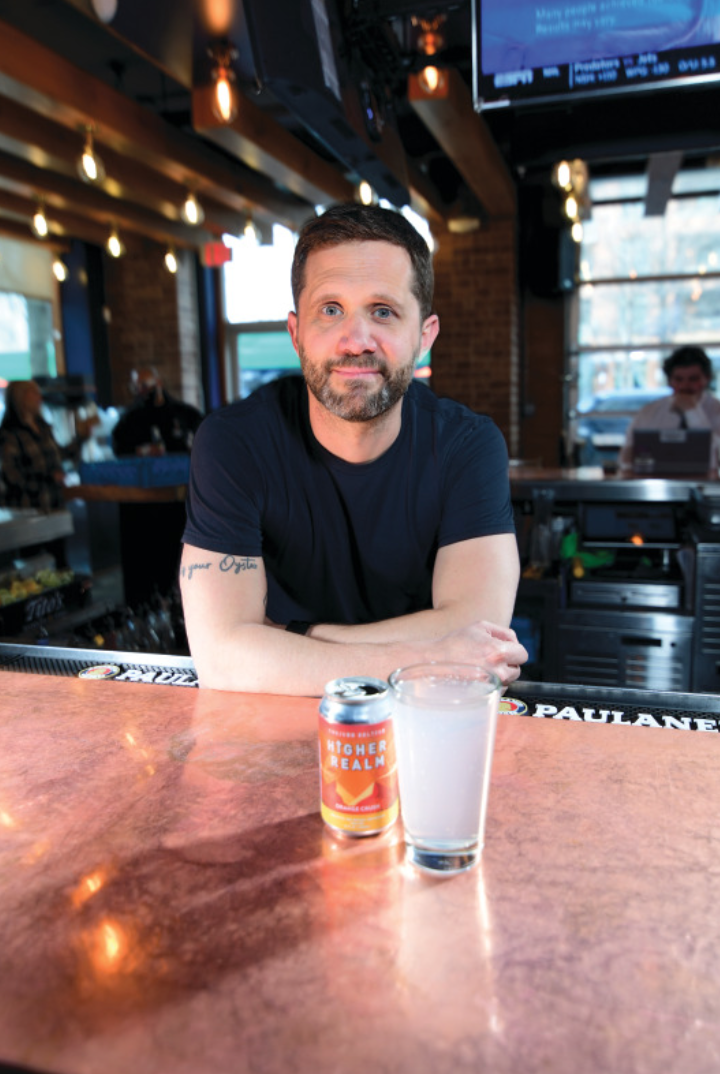
The demise of alcohol certainly seems greatly exaggerated during a late February happy hour at Bronson Bierhall in Ballston. It’s 5:30 p.m. on a Wednesday and the bar is doing a brisk business in a space marked by communal tables underneath brick archways.
Corporate bros in quarter-zips and leather sneakers belly up to the copper-topped bar to order half-liters of beers from Virginia and Germany. Hardier types sport hats affiliated with one military branch or another. An AI technology company has its own corner reserved for a private event.
No one but me is here to get stoned.
The Virginia Department of Agriculture and Consumer Services maintains a list of businesses that register to sell hemp products. Of the 12 listed for Arlington, only three are restaurants: Bronson Bierhall, Westover Taco and Cowboy Cafe.
When I ask about the cans of Higher Realm THC seltzers stored in a fridge full of beer, a nice bartender in a flannel shirt tells me she prefers the blueberry acai flavor over the Orange Crush, plus it has 0 grams of sugar. Each seltzer, produced in Atlanta, contains 2 milligrams of THC, the maximum allowed for sale of an edible product in the state of Virginia. There’s also 2 milligrams of nonpsychoactive CBD.
Over the next hour and a half, I drink three cans at $10 apiece. About 20 minutes in, I notice a tiny head rush, like a tingle behind my eyes. It feels like I’m hydrating. I become keenly aware of the squeak of fried cheese curds under my teeth as I watch spring training baseball and TGL golf on the wall-to-wall screens. I giggle to myself as I consider the idea of “flaming fajitas” in a literal sense.
I observe the crowd while sipping my silly soda and making conversation with a military contractor with an impressive mustache. Aside from one espresso martini, everyone else around me is drinking beer. When it’s time to take the Metro home, I leave with my wits pretty much intact.
Scott Parker is a partner in Bronson and dozens of other area businesses, including Don Tito, Nighthawk Brewery & Pizza and the Bearded Goat Barber. He says the THC drinks have been selling relatively well in the six months since Bronson brought them on.
With the 2 milligram dose, he says, a customer could feasibly consume as many as four or five cans over the course of an evening. According to Parker, some patrons come to Bronson specifically because they know they can find the THC seltzers. Some may identify as California sober, like he does, and are delighted to find an option for them when they arrive in a group.
For first-timers, he adds, the familiar format of a 12-ounce can be less intimidating than cannabis in other forms.
Given its location two blocks from the Ballston Metro and its popularity for corporate events, Bronson is well positioned to remain a successful bar. Parker sees it as an exception. “Alcohol is facing an absolute reckoning,” he says. “I’ve been warning my bar-owning friends about this.”
For him, the reckoning is also deeply personal. He quit drinking 15 years ago.
“I wasn’t happy. I wasn’t healthy. I wasn’t feeling good physically the more alcohol I consumed,” he shares candidly. “I wasn’t the person I wanted to be. I wasn’t the family member I wanted to be. I wasn’t the businessman that I wanted to become. I was violent at times. I was angry. Marijuana on the other hand never really gave me any of those problems.”
The only downside? “Too much ice cream.”
Edibles are his preferred vice, typically sourced from legal dispensaries in Maryland or wherever he may be traveling that’s above board. As a daily user, he says he’s sometimes ingesting up to 40 milligrams when the workday is finished. “It’s been a great way for me to cope…take the edge off. An escape if you will.”
Gabe Hiatt is a food and travel writer based in Washington, D.C., who has led teams of reporters for Eater and The Washington Post.