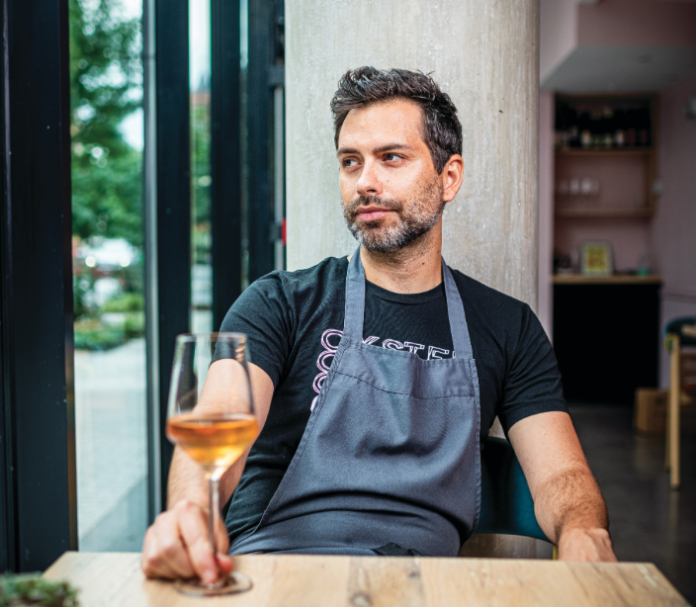
It’s been 13 years since Rob Rubba landed in Northern Virginia, nine since his last bite of meat, four since his (mostly) vegetarian D.C. restaurant Oyster Oyster earned its first Michelin Star, and three since the trailblazing chef and Arlington resident garnered a prestigious James Beard Foundation award.
These days he lives in Aurora Hills with his wife, Deb, a chess academy program director, and their two kids. It’s a significant change of pace in a career that previously had him crisscrossing the country (New York, Vegas, Chicago, Philly) in service of celebrity chefs such as Gus Savoy, Gordon Ramsay and Charlie Trotter.
In the DMV, Rubba won fans cooking for Neighborhood Restaurant Group properties—first Tallula in Lyon Park (which shuttered in 2014), and later, Hazel in D.C.’s Shaw neighborhood (also closed), where the accolades rolled in for dishes such as tempura-battered sticky pork ribs and duck bao buns. That was before he gave up meat and embraced a plant-based lifestyle.
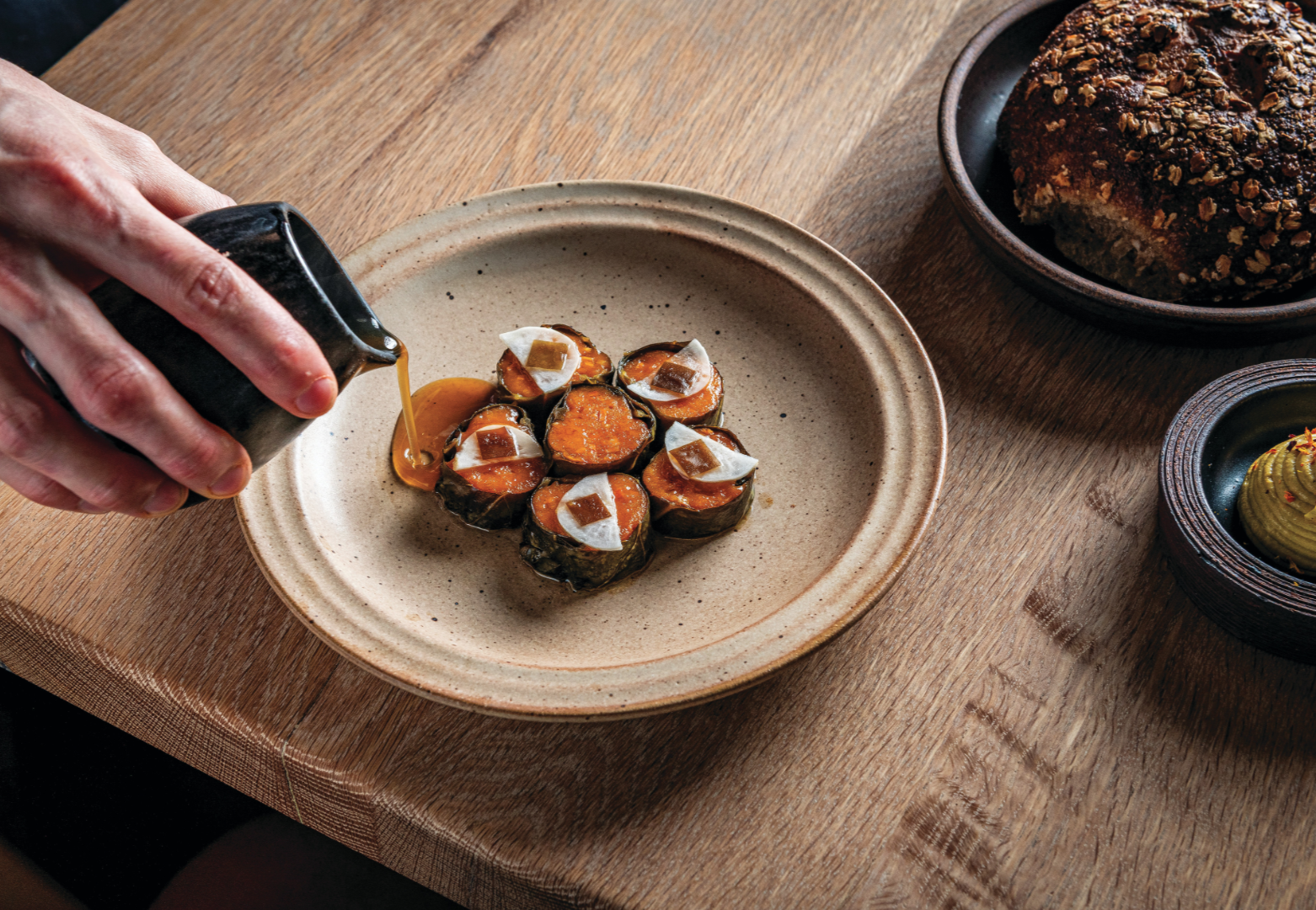
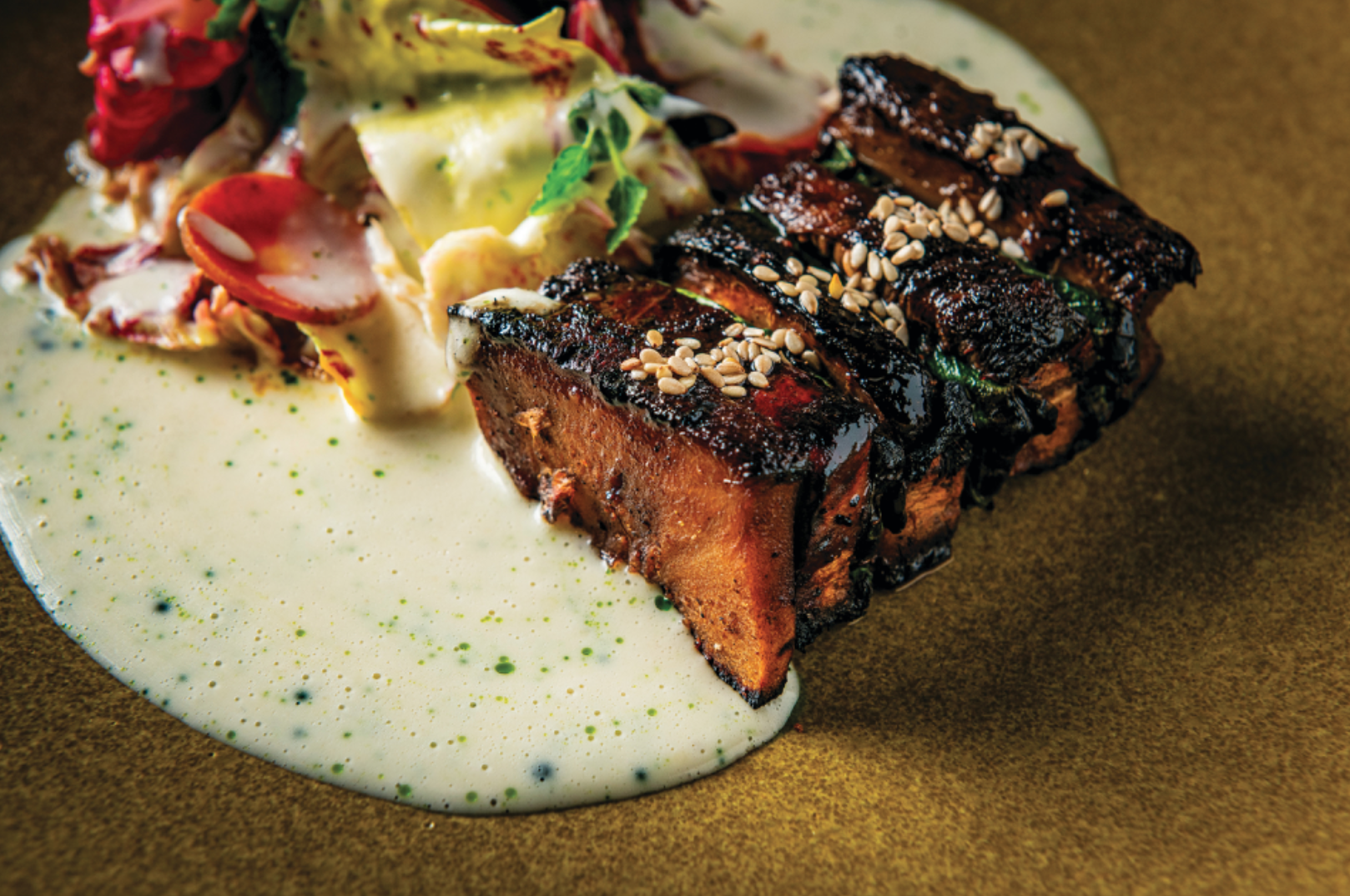
At Oyster Oyster, his boundary-pushing temple to seasonal dining, the chef’s ingenuity shines in what could be described as the vegan version of nose-to-tail cooking. Vegetable scraps are converted into seasonings, used cooking oil is recycled to make candles, and nothing is wasted. (The name of the place references both oyster mushrooms and the sustainable bivalves representing the only animal protein on the menu.)
It’s a virtuous endeavor, but Rubba’s not one for proselytizing. His creative and flavorful cooking speaks for itself. We sat down with the chef at Rare Bird Coffee Roasters in Falls Church to chew the fat about, well, everything. Here’s what was on his mind.
How did you end up moving to Arlington?
I got a job at Azur [now closed] in D.C.’s Penn Quarter in January 2013. At that point, my wife and I had worked in cities for almost 10 years. It was just like, “Let’s try something a little slower.” You know, see a few more trees.
What was it about Aurora Hills that appealed to you?
Having space to garden. I was part of the Lang Street Community Gardens for a number of years, and it was cool to be a part of that community. Now I’ve got beds in my backyard. In spring and summer, I grow tomatoes, peas, eggplant, zucchini, cucumbers and a wide variety of herbs. In the cooler months, I grow carrots, kale, lettuce, beets, turnips and winter squash. I try to grow just about everything I can.
What prompted you to become a vegetarian in 2017?
I started reading about environmental waste and the ecological harm and health hazards associated with factory-style livestock farming. I realized how unsustainable restaurants can be. I knew I needed to change how I consumed as a chef if I wanted to change what was on the plate.
Oyster Oyster has some devoted fans. Who makes up your clientele?
It’s pretty diverse. We have guests who are just really interested in great food, great cuisine. Then there are guests who are very environmentally focused, or who are coming in for animal rights reasons. Some people just love the way they feel when they eat there.
Do you ever get any pushback for not serving meat?
If we’re going to support agriculture, if we’re going to talk about seasonality and sustainability, meat gets in the way of that story. If I put beef on the menu, it’s going to taste pretty much the same year-round. A restaurant like Oyster is all about intention and personality. I feel like being in the nation’s capital, we have an opportunity to make change, to make a statement.
So the menu tells a story?
Yes. I think it just keeps improving. We’re into this kind of lifecycle menu where an ingredient you have in one course, some element of that dish, instead of becoming waste, incorporates into the next one.
Can you give an example?
The welcoming broth we serve when you first sit down is based on dried mushrooms from the summer, plus sugar kelp, and we finish it with a charred onion oil. To make it, we use mushrooms, carrots, onions, etc. and strain off the vegetables to get a delicious, rich broth. But then there’s all that leftover stuff we’ve strained out. We dehydrate it and blend it into a powder. It’s the best seasoning! We do these kohlrabi dumplings filled with pear and radish and root vegetables. There’s a pear sitting on top that we dust with that dried mash from the broth. This is something that would normally get thrown away.
One man’s trash, as the saying goes.
That’s the idea. Over the winter, we did a sweet potato mochi. We made a puree of sweet potato and sweet potato starch, stuffed it inside marinated collard greens, steamed them and then sliced them into little pieces. And then all the skins from the sweet potatoes, we roasted and smoked them. The resulting seasoning is similar to katsuobushi [bonito flakes] or dashi. You wouldn’t believe the smokiness and the earthiness you can derive from those scraps.
Well, you loved on it quite a while to get it to that state.
Yeah, exactly. A lot of love goes into it. And thought. But that’s the thing. Instead of viewing these ingredients as waste, we talk about them as being parts of a whole and how delicious they all are. We want to show how delicious everything can be—and is.
Are people ever surprised by the experience?
I think there’s still some education to be done. How we operate is very forward-thinking. It’s not so much about telling people to eliminate meat. It’s more of an emphasis on vegetables and local agriculture to build stronger food systems and more circular economies. Our farmers use regenerative farming practices and organics, connecting us to the seasons and nature. We work with local mills for our flour and grains, and local foragers for native plants and mushrooms. Even our sea salt comes from the Delaware shores and West Virginia mountains. Almost everything we cook with comes from the Mid-Atlantic.
So no preaching or diet shaming.
No. I don’t want it to feel like we’re being didactic, like this is the only way to do it. It’s more about finding fun ways to weave in our ethos, the creative things we’re doing, the farmers we’re working with, versus taking a superiority approach that’s performative. Frankly, it would be easy, financially, to put animal proteins on the menu. I guarantee if I said, “You know what, we realized we can get this really great, sustainably grown duck or this really good fish,” and I put that on Oyster’s menu, we’d be twice as busy right now. As a businessperson, maybe it’s silly not to. But in terms of standing up for what we believe in, our choices are important.
Does that philosophy extend to your bar program?
We have a wonderful selection of biodynamic, vegan, organic and natural wines. On the beer front, we work only with breweries that use local ingredients, which means Mid-Atlantic grains, local yeast and hops. We recently introduced our first cocktail, made with imported Nàdar gin [which is distilled from peas in Scotland], dried lemon verbena and Gold Rush apple trimmings.
Ingredients aside, how are you keeping things fresh?
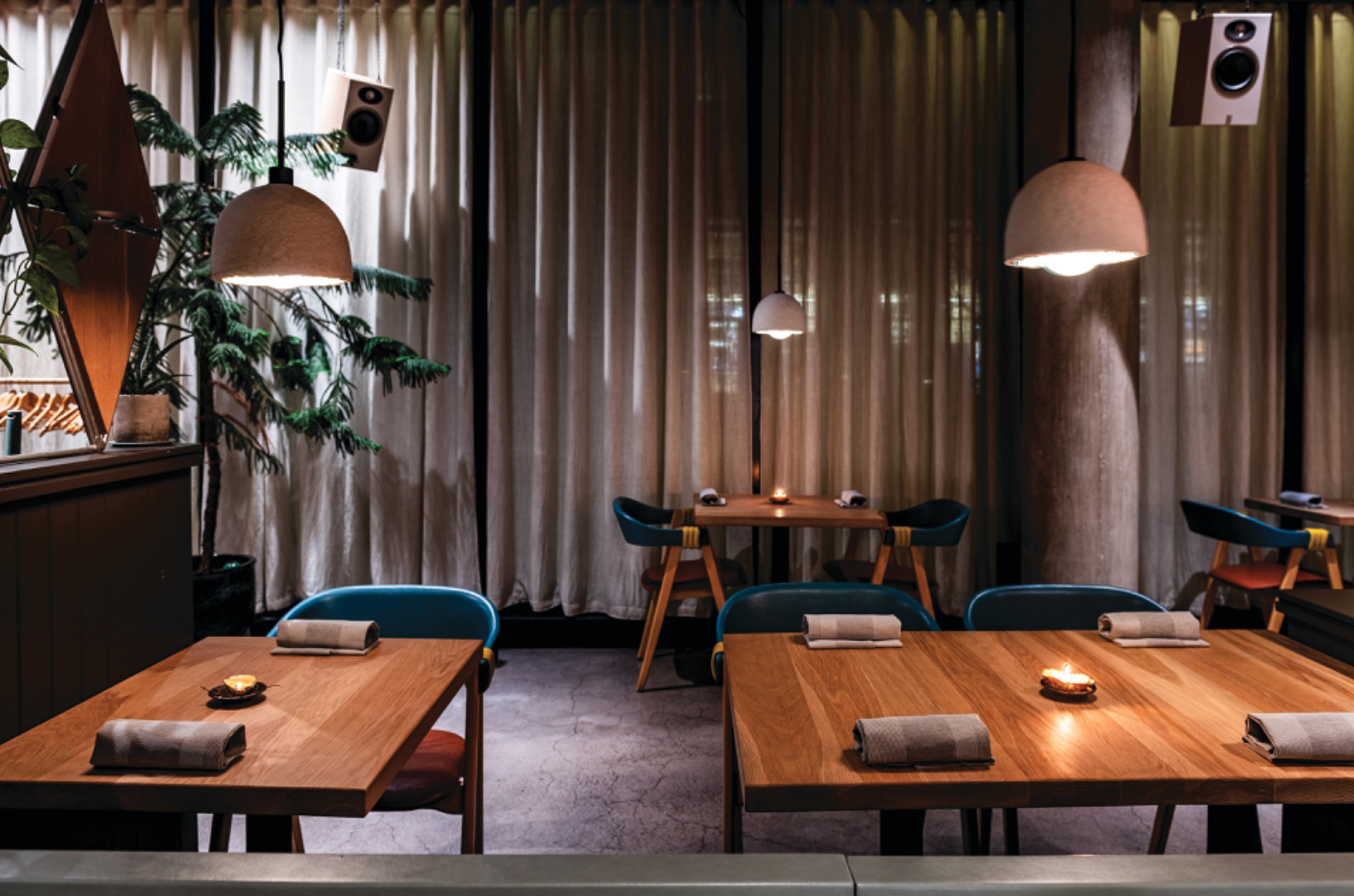
We’ve recently done some renovations, so the dining room feels more like what the food feels like. We added curtains made from sustainably sourced wool, more intimate lighting, and reclaimed and native wood. There’s a little more escapism now when you walk in. The light pendants above our tables are made from hemp forms covered with mycelium and then baked. It’s just like a mushroom, naturally grown, and is a completely biodegradable material. One day, when the restaurant is gone and someone comes to clear it out and throw all this stuff away, the lampshades will break down.
Do other chefs ever come to you for advice?
We get tons of questions from our peers and other restaurants. We’re an open book. We don’t want to be doing something novel. We’d love for everybody to adopt similar sustainable practices, whether that’s mitigating waste or composting. At Oyster, we avoid single-use plastics. We consider them non-essential or obsolete. That goes for our purveyors, too. The farmers we work with deliver everything in a crate. We unload the crate, put the food into our reusable storage containers and then they take their crate back. Closed loop systems are really important.
Do you share recipes? Culinary techniques?
Questions about things like fermentation or pickling or preservation, we’re open books about that, too. We’ve had restaurant friends—and some who became friends—send members of their staff to stage and learn from us for a few days.
Any particular type of customer you are trying to win over?
Our doors are open to anyone who wants to dine with us. I feel like we have an opportunity to change minds and inspire people. We’re going to tell you about our ethos when you dine with us—whoever you are. And if one little thing we did inspires you to make a change, great.
Change as in becoming vegetarian?
It doesn’t have to be that dramatic. Around the holidays, we see a lot of students or young professionals who live in D.C. and their parents are in town, footing the bill. So you’ve got dad, who’s never had a vegetarian meal in his life, eating at our restaurant, and by the end he’s like, “Holy shit! Wow!” Maybe now, when he goes out, he’s still going to order a meat protein for the entree, but he’s going to look at the vegetable options for the appetizers and say, “You know what? I think I can do that.” Our restaurant is for everyone. Yes, it is vegetarian or vegan when you’re eating here. But at the end of day, it’s just delicious food. If that experience leads someone to eat one less [meat-based] meal a week, if they are making that choice, there’s an impact.
Where do you eat when you’re off the clock?
If we’re getting pizza slices, it’s Andy’s. Chili Wok in Alexandria has good Sichuan and their veggie options are great. Padaek by Seng Luangrath is right around the corner. We cook a lot at home, too. We do hot pot nights, fresh pasta, kimbap, tacos.
What about downtown dining?
I think what’s happening at Union Market is really interesting—all the food halls and seeing those old buildings being repurposed. Popping into Yellow or La’ Shukran is always solid. For oysters, the Cordelia Fishbar that Clyde’s opened there is really good.
Groovy. What does the rest of your day look like?
Well, I’m going to grab a bag of Rare Bird coffee for my wife—she’s a fan—and then pop into CD Cellar and dig around in the record stacks for about an hour. My taste in music is very eclectic. I listen to everything from classical and jazz to hip hop, rock, funk and doom metal. A typical purchase might include Ahmad Jamal, Sleep, Grand Puba or The Beatles. Sometimes I will buy whatever the store happens to be playing. Then I’ll head into work by noon, hold a manager meeting, prep and get ready for service.
Do you ever get tired of cooking?
Accolades don’t get me away from the stove. I still like cooking. That’s what I want to do. I’m not really interested in having, like, 30 restaurants. Two or three would be nice. But we’ll get there.
Warren Rojas is Arlington Magazine’s dining critic.