
In February of 2025, much of the country was glued to the news, trying to keep up with a flurry of executive orders emanating from the White House. Jane Andelman was glued to her laptop, applying for jobs.
Andelman, a project manager at an Arlington-based international development nonprofit, had been furloughed after President Trump issued a 90-day hold on foreign development assistance, including contracts funded by the U.S. Agency for International Development (USAID).
“I was like, ‘Well, clearly, there’s a good chance that this is not going to come back,’” she recalls. “A lot of people felt like the writing was on the wall.”
It was for her. Weeks later she was officially laid off, ending her 24-year career with an organization from which she’d hoped to retire.
“That was one of the most difficult times. No one was even hiring in other industries,” says Andelman who, like 42% of Arlingtonians over the age of 25, has a graduate degree. “Everyone was in this wait-and-see mode because there was so much upheaval.”
Andelman and her husband, Jason, began talking about what to do next and whether they’d even stay in Arlington. One of their daughters was in college and the other was soon to graduate from high school. They had equity in their home in Dominion Hills as well as some savings. Should they sell the house and relocate? They’d already been thinking about moving out West.
“The layoff and the fact that I wasn’t able to immediately find another job gave us the opportunity to ask, ‘All right, well, what’s keeping us here?’” she says.
At the time of this interview, Jane was working part-time as a barista and food delivery driver in Colorado while continuing to look for full-time employment. But they haven’t put their Arlington house on the market—at least not yet. Their future is still in limbo.

Last year, more than 348,000 federal workers voluntarily or involuntarily separated from the government as the newly created Department of Government Efficiency (DOGE) slashed and burned its way through one agency after another, gutting the ranks of the nation’s civil service.
In the D.C. region, federal employment fell by more than 54,000 jobs, according to the Brookings Institution. Also swept up in the fray were consulting firms, think tanks, nonprofits and contractors that do business with the government or rely on government grants to fund their programs. Revenue shortfalls left many private sector employers with no choice but to issue their own layoffs.
“These impacts will flow through the region’s economy over the coming months and years including total employment and the housing market,” states a January 2026 report from the Stephen S. Fuller Institute for Research on the Washington Region’s Economic Future at George Mason University. The report forecasts another 20,000 job losses in the DMV as a byproduct of reduced household spending. Service businesses such as hair salons, housecleaners and landscapers could feel the effects.
Prior to DOGE, one in 10 workers in the greater D.C. area was employed by the federal government, including some 175,000 Northern Virginia residents.
But the full magnitude of the impacts is still TBD. From late 2024 to the end of 2025, Northern Virginia’s unemployment rate rose from 2.2% to 3.3%—increasing faster than the national average yet still hovering below the 4% threshold that economists consider “the natural rate of unemployment,” says Keith Waters, assistant director of GMU’s Fuller Institute.
On the housing front, active listings in Northern Virginia ticked up faster than in other parts of the Mid-Atlantic region. “This is very reasonably attributable to the DOGE impacts,” Waters says. But home prices held steady.
The median sale price for a single-family home in Arlington was $1.3 million in 2025, up from $1.29 million the year prior, according to real estate listings platform Bright MLS. Falls Church saw its median sale price increase from $949,000 to $1 million over the same time period, while McLean’s fell slightly, from $2.25 million to $2.1 million.
“The Northern Virginia housing market is not going to fall off the cliff,” Waters says. “What we’re seeing right now is basically price stability, probably through this year. Everything just calms down for a little while.”
Local Home Sales Before and After DOGE
The charts below reflect residential real estate activity over the past five years in the 16 ZIP codes that make up Arlington, McLean and Falls Church. Houses took longer to sell in 2025 as market conditions cooled, but the volume of transactions held steady and home prices remained high.
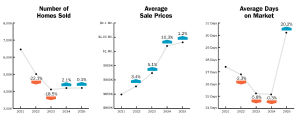
Lisa Sturtevant, chief economist at Bright MLS, attributes two distinct spikes in Northern Virginia’s housing inventory to DOGE cuts. In March of 2025, active listings in Arlington, Alexandria, Falls Church, Fairfax County and Loudoun County were up by 28.3% compared with the year prior. September 2025 saw a year-over-year increase of 13.8%. Both jumps aligned with the timing of Office of Personnel Management deferred-resignation announcements and end-of-fiscal-year resignation dates.
A June 2025 survey conducted by Bright MLS found 37% of real estate agents in the greater D.C. area reporting that they had worked with a client who was buying or selling due to DOGE-related layoffs. Sales prompted by retirements also saw an uptick of 5 percentage points. But because the region had so much “pent-up demand” for housing, prices didn’t take a hit.
“A lot of people worried prices would fall and demand was going to fall out of the market,” Sturtevant says. So far that hasn’t happened. “Prices remain pretty stable. High-income buyers were still out there. We’ve seen price growth soften as inventory has increased, moving more towards a balanced market in the D.C. area, [but] we haven’t seen…year-over-year price declines.”
Industry observers note that many would-be buyers and sellers are currently in a holding pattern, taking a wait-and-see approach. Although mortgage interest rates dipped in late 2025 (down from 7% at the start of that year), they still are hovering around 6%. That’s keeping folks who have a much lower rate on the sidelines. Meanwhile, trade wars, actual wars and civil unrest have created a climate of economic anxiety.
“It’s still a very uncertain time in the Washington area,” Sturtevant says. “There are people who…either lived through DOGE or lived through the longest government shutdown in history, and are like, ‘We would like to make a move, but we’re feeling a little uncertain right now.’ Buyers and sellers are moving with extreme caution in early 2026.”
In February, closings across the Mid-Atlantic region were down 1.1% over the prior year, according to Bright MLS, while the median number of days on market was 27—more than a week longer than in 2025.
Whether the 2026 spring selling season will mark a turning point remains to be seen. Sturtevant says the U.S. military action in Iran has made the outcome harder to predict.
“If the conflict with Iran is limited, the housing market could rebound quickly,” she says. “However, a prolonged conflict could stall home sales activity this spring. The [potential for] declining seller inventory and cautious buyers creates uncertainty about whether the market will tighten or continue its move toward balance.”

Some say the pandemic—even more than the political climate—set the table for the market’s current stasis. At the start of 2021, the interest rate for a 30-year fixed mortgage hit a record low of 2.65%. Home prices surged. Inventory was gobbled up by buyers who could afford to overbid. Sellers were receiving multiple offers and closing above list price. Home sales nationwide reached their highest level in 15 years, with some 6.12 million units sold.
In Northern Virginia, a profusion of high-income earners lifted home prices even higher. Arlington’s median household income is about $142,000, according to Census data. That’s roughly 70% higher than the national average of $83,730.
But for the past three consecutive years, home sales nationwide have held steady at about 4 million units annually—the lowest level of activity since the mid-1990s. The D.C. metro region isn’t faring much better, says David Howell, executive vice president and chief information officer for Corcoran McEnearney. “Across the board, it’s just been flat activity.”
American wages haven’t kept up with the rising costs of food, housing, childcare and other expenses. To resume pre-pandemic housing affordability levels, home prices would need to hold steady and household incomes would need a 15% bump, according to a February mortgage report from the Intercontinental Exchange, a multinational financial services company.
“We have never seen circumstances where the affordability equation changed so rapidly,” Howell says. “Home prices went up so fast, and mortgage interest rates went up [as well]. That one-two punch has hurt an awful lot of people who would like to buy a home and right now, in this environment, really can’t.”
Some would-be buyers are Millennials who are delaying purchasing a home while also delaying marriage and children. Homeownership is harder to achieve on a single income.
For Heather Devoto, vice president and branch manager at First Home Mortgage in McLean, the volume of contracts generated in 2025 wasn’t much different from the year prior. But some of her colleagues along the East Coast offered bleak updates at a recent sales meeting. “Last year was a very difficult year for people,” she says. “People weren’t buying, people were struggling, people’s contracts were falling out.”

So far, the mass exodus many feared would be triggered by DOGE is not reflected in leading market indicators. Analysts offer multiple explanations, starting with the fact that the region’s economy is not a monolith.
Federal civilian jobs account for only 12.5% of all jobs in Arlington, Fairfax, Loudoun and Prince William counties, and the cities of Alexandria, Falls Church, Manassas and Manassas Park, according to the Northern Virginia Regional Commission.
“Even with private sector employment tied to the federal government, there are still many people employed in other industries who did not feel the impact of the layoffs and budget cuts,” says Sturtevant of Bright MLS.
Many households impacted by layoffs had another income earner to fall back on. “With the high number of two-worker households in the region, when one person loses a job, it is not necessarily true that the whole household has to move,” she adds.
Some federal workers who opted for the deferred resignation program were close to retirement age. Some had already paid off their homes, and can now tap into their pensions.
Others who’ve left the area to find work elsewhere are keeping their homes in the DMV as rental properties.
Statistically, Howell says, the impact on housing metrics of federal layoffs and slashed funding has been modest. But for those directly affected, the fallout feels profound. “If you lost your job, or your spouse lost their job, or your next-door neighbor lost their job, it’s a tragedy,” he says sympathetically. When USAID was gutted, a couple of buyers with pending transactions in Corcoran McEnearney’s Arlington office pulled their contracts. “It’s really tough, and I’m not exaggerating that.”
Inventory is now inching back up as houses spend more days on market, giving buyers more leverage. Sturtevant says that trend could continue if sellers who’ve been on the fence decide to shed their ambivalence. “There is a lot of pent-up supply, as existing homeowners who want to move for family or financial reasons have been holding back,” she says.
What could quash that momentum is more change in Washington. “The things that could be headwinds or affect the market negatively are if we have continued government shutdowns,” she says—or if the Trump administration continues to relocate substantial portions of the federal workforce outside of the District, as it is doing with the U.S. Departments of Housing and Urban Development and Agriculture.

Steve Wydler, co-founder and an associate broker with Wydler Brothers of Compass, will be the first to tell you that jobs are the number-one driver of residential real estate transactions in the suburbs around D.C. But in his experience, people don’t immediately move if they suddenly become unemployed.
“If someone loses their job, they’re actually much more likely to stay put than move,” he says. “If you don’t have a job, it’s very hard to move because you can’t rent or buy unless you have a lot of savings.”
Mortgage interest rates are also playing into the present inertia. People who purchased a home or refinanced during the pandemic, when borrowing was cheap, may be inclined to stay locked into those historically low rates, even if it means delaying a move to a more desirable home or location.
“There were an awful lot of people who might have sold, but if they were buying up, if they were going someplace else, they’d be giving up a very low mortgage payment,” Howell says.
The DOGE effect on home sales is harder to quantify. Michelle Sagatov, an Arlington-based agent with Washington Fine Properties, says that at the start of Trump’s second term, some of her clients channeled their feelings of uncertainty into action.
“[Some sellers] decided to actually move sooner rather than later,” she says. “They didn’t really want to deal with this administration, so they ended up listing their houses earlier than planned and moving earlier than planned.”
These days, she’s seeing listing decisions accompanied by feelings of resignation, a reluctance to put life on hold. “Things are moving. Buyers are ready. Interest rates are helping,” she says. “I think people are desensitized to the political climate. Whereas last year it was like whiplash, this year, they’re like, ‘We’ve seen it all…We need to buy a house.’”
Even amid feelings of unease, life marches on. “People are getting married, they’re having babies, they’re getting divorced, they’re getting jobs,” Wydler observes. “Yes, you can sometimes delay those decisions, but eventually people are going to have to move one way or the other.”
The Andelmans may not be calling Arlington home for much longer. In March, they temporarily relocated to Durango, Colorado, while renting out their house in Dominion Hills. As this story went to press, they were discussing whether or when to sell it.
They’ve cut back on expenses as they contemplate what their next chapter might look like. Reflecting on the prior year, Jane says she’s found a silver lining in all the turmoil.
“It’s given us the opportunity to step away from everything that’s happening in D.C.,” she says, “and allow ourselves a break.”
Eliza Tebo is a writer, vocalist, podcast host and longtime Arlingtonian.