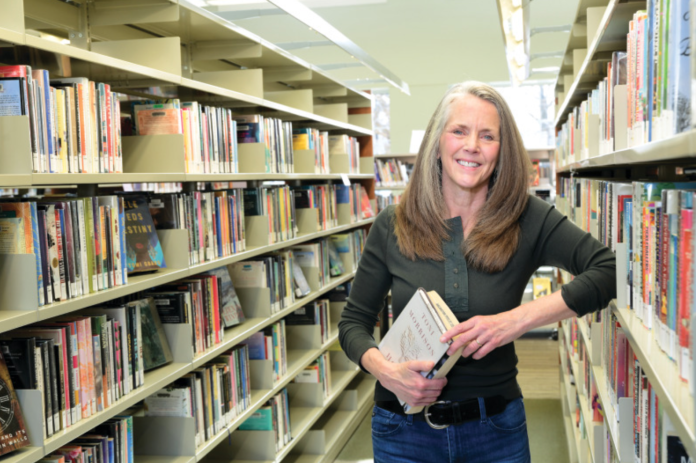
Kelli Taylor remembers the first time she walked into the D.C. jail in 2002. She and her friend Tara Libert were there to determine if their idea for a book club could flourish in a place that wasn’t known for nurturing and growth. What they did know, having both worked in journalism, was that words had meaning and power. So they sat down in a room and waited.
Soon, a group of incarcerated youth walked in, and they all began to talk—about books and writing, but also about life. With that one conversation, the Free Minds Book Club & Writing Workshop was born. “Some of them were just kids,” recalls Taylor, who lives in Westover with her husband, Rich.
It wasn’t the first time Taylor had exchanged ideas with someone on the inside. In 1996, she was working as a D.C.-based television producer for an Australian broadcasting company when she received an unsolicited letter from a man named Glen McGinnis who was on death row in Texas. Imprisoned for a crime he committed when he was 17, he’d reached out to several journalists, hoping someone might be interested in his story. Taylor was the only one who responded. She produced a documentary film about him and continued to correspond with him in prison.
McGinnis was an avid reader, and books became their common language. One bestseller they discussed was Into Thin Air, Jon Krakauer’s famous account of the 1996 Mount Everest disaster. “Glen was very skeptical,” she recalls. “He was like, ‘Life’s hard enough. Why are you going to try to climb Mount Everest?’ But it’s a story about survival, and that’s a universal human experience.”
Inspired by their exchanges, Taylor teamed up with Libert and laid the groundwork for a program to bring literature into the D.C. criminal justice system. What began as a single book club soon grew into a nonprofit that facilitates in-person book discussions inside jails, as well as a correspondence-based book club for people in prison. (Because D.C. does not have a long-term prison, jailed individuals often end up serving out their sentences elsewhere.)
Operating with a staff of about 17, including formerly incarcerated book club members, Free Minds has served some 1,500 people since its inception. The group publishes a literary magazine written by and for incarcerated authors, and offers a re-entry book club for formerly incarcerated people returning to their communities, as well as workforce and leadership development programs. Taylor served as executive director for the first eight years and then stepped into the role of book club manager. Libert, a D.C. resident, is now the executive director.
Today, the nonprofit has dedicated book clubs for juveniles, adults, women and Spanish speakers. Reading selections are chosen by staff or suggested by participants. Recent books include The Light We Carry by Michelle Obama, Where Tomorrows Aren’t Promised by Carmelo Anthony (with D. Watkins), The Body Keeps the Score by Bessel van der Kolk, and An American Marriage by Tayari Jones. Numerous authors have come to speak, including Jonathan Franzen, George Pelecanos and Kenji Jasper.
“We try to present a diverse ballot of books for members to vote on, which is harder than you’d think,” Taylor says. “If you and I were to gather a bunch of friends for a book club, we presumably would have a lot in common.” Often, the only thing Free Minds members have in common is that they’re incarcerated.
Some participants don’t want to read stories about people in jail. Others struggle to relate to stories centering on lives of privilege. “We tell people, even if you don’t like it, read it and tell us why you don’t like it,” Taylor says. “We do a lot of memoirs. The goal is to show transformation, and memoirs are awesome for that. I’m always surprised by what they like or don’t like.”
Equally important are the writing opportunities that Free Minds provides. Through its ongoing writing workshops, incarcerated youth and adults are offered time and space to write poetry, essays and spoken-word pieces. They receive structured feedback from staff and their peers, and work on submissions for the literary magazine.
In March 2025, several Free Minds members who are no longer incarcerated participated in an evening of poetry and visual art at the Kennedy Center’s REACH facility, reading their own work as well as works by writers who are still serving out sentences. The event, titled “Poetry & Art as Liberation: Stories of Hope and Resilience in the Prison System,” was co-sponsored by the Second Look Project, a nonprofit working to end mass incarceration and severe sentencing in the D.C. justice system.
Taylor says the act of writing allows participants to envision themselves in new ways that can be a catalyst for change. “When somebody reads, and people are snapping [the preferred form of applause in the poetry slam tradition]—it sounds really cliche, but you just see people light up. It goes back to just being seen and heard.”
Writing also helps participants overcome feelings of worthlessness that feed into cycles of crime or violence. “I don’t want to generalize, but…a lot of them feel that they are the thing that they did or may have done,” Taylor shares. “When they write something and we hand them back their poem and it’s typed up, they’re like, ‘I’m a writer.’ They suddenly have a new identity.”
This was true for Rafael Douglas, who first encountered Free Minds in juvenile detention and became more active as an incarcerated adult. Released in 2021, Douglas now lives in Fort Washington, Maryland, where he owns an epoxy flooring business.
“I started writing poems in jail. It was a great relief to put my feelings on paper,” he says. “Kelli would write me letters and postcards. It really made me feel connected and human, especially coming from someone from a different walk of life. Free Minds helped me stay on the route I wanted to be on, to not ease back into violence and criminality. They gave me a place to be comfortable trying to be a new person. It changed my life.”
In addition to the literary magazine, Free Minds has published several anthologies of collected works by members. The public can engage with poets’ writing, offering feedback through in-person events, like one recently held at the Westover library, and on the Free Minds website.
At On the Same Page: Write Nights, listeners are handed copies of poets’ work and are invited to annotate them—underlining, adding stars or smiley faces, and making comments—which Taylor says is highly validating.
Many poems posted on the website reveal beauty and lyricism, along with depth, frankness and clear-eyed realism. A poem titled “While I was Sleeping,” by a writer with the initials RL, ends with these words:
and like any soul
who Morpheus claims
I will find freedom tonight
with hope and a sweet
whisper of peace
in my mind’s eye
and dream of
going home
Some might question whether the nonprofit’s work excuses or ignores the damage and pain inflicted by crime. Taylor says accountability is essential, and she acknowledges that some book club members do go on to commit other crimes.
“Our work isn’t about excusing behavior; it’s about creating space for reflection, responsibility and growth,” she clarifies. “Our members are encouraged to face the past honestly, take ownership and decide who they want to become. Some of our most powerful moments involve individuals confronting and working to repair the harm they’ve caused.”
She’s apt to quote Bryan Stevenson, author of the acclaimed book Just Mercy: “Proximity has taught me some basic and humbling truths, including this vital lesson: Each of us is more than the worst thing we’ve ever done.”
It’s emotional work—particularly when members land back in jail or are killed. “Every time it happens, I think, I don’t know if I can keep doing this,” Taylor says. “It’s really hard.”
At one point, she hit pause. “By the time my [own] kids were in high school…I just didn’t feel like I was giving my best—that I could do my best for both—so I stepped down completely. Then, around 2011, I agreed to come back to help with the book club, and it was like I had never left.”
Currently, Free Minds is advocating against efforts to repeal the Incarceration Reduction Amendment Act (IRAA) and the related Second Look Amendment Act. Both are D.C. laws stipulating that people who were under 25 at the time of their arrest and who have served at least 15 years of their sentence can petition a judge for resentencing. In February, the organization released a booklet of stories from formerly incarcerated youth and young adults about how IRAA allowed them to get back on their feet.
“Beyond the books and writing, what’s so powerful is the sense of belonging,” Taylor says. “So much of what people do wrong is because they don’t feel like they belong,” whether that’s joining a gang or thinking a certain status symbol will bring them the validation they seek.
This makes the re-entry book club especially important. “Our goal is for when they come home, they have a landing place where they can have a chance to succeed,” she says. “By offering positive programming and opportunities for growth, we contribute to their healing, and, in turn, to the healing of the communities they rejoin. We believe this work helps interrupt cycles of violence and supports people in returning safer, more thoughtful and more whole.”
Consider a poem titled “Seeds,” by a writer whose initials are ER:
I spread my roots.
I reach right
For the sky.
I break the ground.
I grow right before your eye.
The future.
What a surprise.
Glen McGinnis never had the chance to come home. In one of his last letters to Taylor before his execution in 2000, he shared that he wanted to establish a prison book club and poetry society.
Although he wouldn’t live to see it, Free Minds is part of his legacy. Taylor says they’ve always considered McGinnis the book club’s first member. “He wrote to me and said, ‘If I had had this growing up, being able to read and write with somebody, I don’t think any of this would have happened.’ ”
Kim O’Connell is an avid reader and writer based in Aurora Highlands.