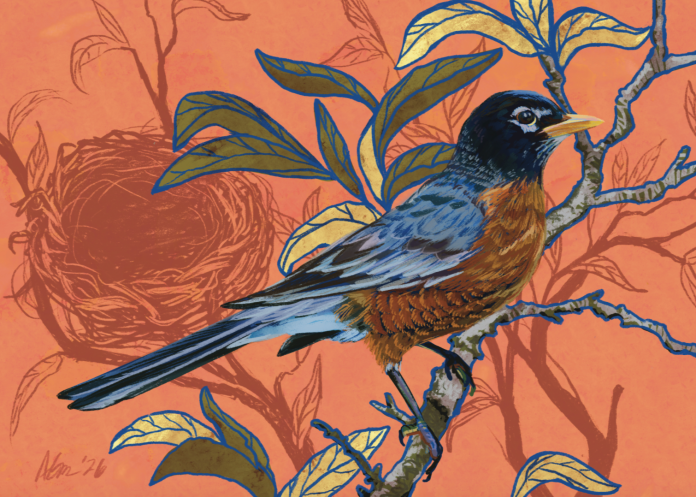
My sister was the first to notice the nest—a seemingly disorganized bunch of twigs and grass that looked abandoned, as if someone had dumped a pile of yard refuse on the patio table and left.
I wasn’t paying much attention, even though the little bundle of sticks was squarely in my line of sight. It sat just outside the basement window of my parents’ house, where I was sleeping on a pull-out couch amid shelves lined with books and my mother’s old sewing machine.
My mom, 83, was ill and receiving round-the-clock assistance from live-in caregivers. My 88-year-old father was in the hospital. I had come up to New York after a radiation oncologist noticed two spots on Dad’s brain that looked like cancer and recommended surgery.
The procedure, called gamma knife radiation, was aimed at freezing the lesions with hopes that Dad could return to his regular routine—swimming and walking every day, lunching with neighbors, talking with me for hours during my monthly visits. He regularly asked how my job was going, what my daughter was doing, what I thought about world events.
But his first priority was always my mother’s well-being. From the time they were married, he was completely and utterly devoted to her. He’d been heartbroken to witness her deterioration, frustrated by his inability to stop it and jealous of friends who were healthy and able to travel together.
Dad didn’t get better after his operation. He kept returning to the hospital for various ailments, staying overnight, or in some cases longer, before finally announcing he did not want any more medical interventions. He was ready to die and wanted to be near his wife of nearly 60 years. So, we brought him home.
A few days later, my sister spotted the nest, and then, a robin perched among the twigs. My first inclination was to walk toward it, but she warned me to stay away, explaining that my gaze might prompt the bird to abandon its home and never return.
From that point on, whenever I went down to the basement, I stood just out of view of the window, glancing at the nest from the corner of my eye. Sometimes there were two birds, sometimes none. My fixation on their instinctive rituals became a relief—something quiet and wondrous to hold my attention as I tried not to fall apart dealing with my parents’ financial adviser, their concerned friends, the ever-present caregivers.
Dad, confined to a hospital bed in the library, was determined to remain in control, dictating emails to family overseas, saying he wanted to visit them but now wasn’t a good time.
After one particularly trying day, I went downstairs to sneak a peek at the nest and saw that it cradled three turquoise eggs, so perfectly oval they didn’t seem real. The robins were nowhere to be seen. Perhaps they were out hunting for food.
I worried the eggs were too exposed, that something might happen to them while their parents were gone. Realizing there was nothing I could do, I busied myself keeping Dad comfortable, stooping down to hug him or hold his hand as he lay with his eyes closed. “You’re a good daughter,” he said.
I couldn’t overlook the irony that as life was ending upstairs, new life would soon appear downstairs.
I was back in Arlington a short time later when my sister called. “He’s gone,” she said quietly.
During his last days, Dad had reached for my mother’s hand, singing the French song “Frere Jacques” to her. They were both born overseas, so perhaps it was a reminder of their native Belgium. Maybe it was a sweet tribute to the tune my mom sang to me and my sister when we were little. I never got the chance to ask.
My return to New York was a fog of funeral arrangements, a memorial service, canceling credit cards, crying in front of people, collapsing on the pull-out couch in the basement.
That’s when I finally noticed the robin was back, and she wasn’t alone. I texted my sister in all-caps: THE MOMMY ROBIN IS TEACHING HER BABIES HOW TO FLY!!!
For the next few days, I stole glimpses of the family unfolding in front of me. I watched the bird tending to her fledglings, their tiny beaks open wide, and something inside me shifted. My father was gone, but another creature had made its home in the place he’d left.
That was three years ago. Now, whenever I visit my mom, I check the table out back for robins. None have returned. Eventually the nest disappeared—perhaps a victim of a rainstorm or a maintenance crew tidying up.
For a while I felt bereft. But then I realized that the birds had comforted me during one of the worst times of my life. They’d given me something to look forward to as I learned to live without my dad.
These days, I look for cardinals outside my home in Arlington. Virginia’s state bird is a year-round neighbor, but I really notice them in the spring when the maple tree in front of our garage starts greening and I remember that my dad died in the spring.
A friend once told me that cardinals are a sign of hope, a way for our loved ones to say they’re still watching over us. And I believe her.
Lisa Lednicer is an editor, writer and Arlington parent whose own daughter is soon to leave the nest for college.