

Mahjong is having a moment, even though it’s been around since the 19th century.
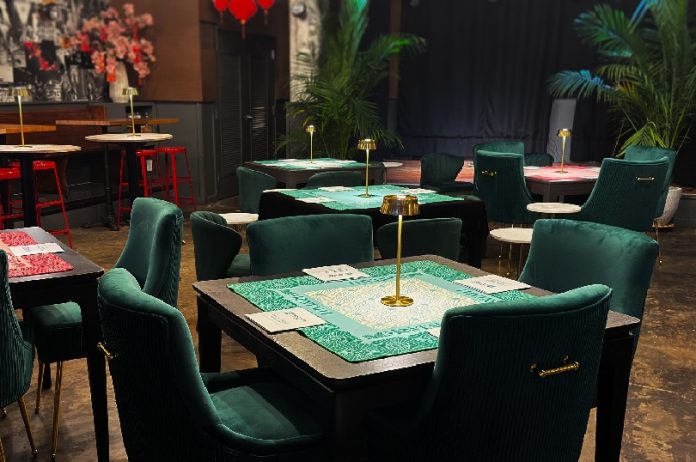
Opportunities to play are popping up all over Northern Virginia. The newest is Montahj Social, a pop-up mahjong studio that will run for three months, starting Feb. 20, at the Ballston Exchange in part of El Rey Ballston‘s space. It’s the latest addition to a bandwagon that includes Upside on Moore’s Mahjong Monday, Tuesday afternoon games at Elevation Burger in Falls Church and Talk Tiles to Me, a dedicated mahjong studio that opened in the Little City in September.
“I fell in love with mahjong post-covid,” says Dana Moss, the Williamsburg resident behind Montahj Social. “I just felt really isolated and friends were playing, and I got completely hooked on mahjong. Then I decided to pivot from my life as a lawyer to trying to open a business that is a mahjong social club.”
Designed for newbies and experts alike, Montahj will offer lessons, guided games and tables that can be reserved for up to two hours of play at a time, although walk-in customers will be welcome, too. A two-hour session will cost $25. Visitors can also buy a weekly pass for $35 with the option of booking one two-hour session every day.
Game Theory
Moss, an Air Force veteran, says the idea came to her after she struggled to find mahjong meeting places. “I play with a group that’s very large. I think that there’s probably 20-plus or so that meet pretty regularly during the week,” she says. “We even have an email group that’s over 100 people. It’s like pickup games: Who can play today? Let’s meet, let’s find a place to play.”
They’d take over tables at the Army Navy Country Club in Arlington, or take turns hosting in their homes. “We’ve played everywhere,” Moss says. “I’ve found space at outdoor tables in National Landing. We’ve played at restaurants.”
Montahj will take the legwork out of finding a flat surface for the tile-based game. The studio can accommodate roughly 24 players per two-hour reservation block, and players will have access to a food and drink menu tied to El Rey. In addition to the taqueria’s regular offerings, a special mahjong menu features shareable plates and signature cocktails such as a Montahj Margarita and Fire Horse Paloma.
The latter is a nod to the this year’s lunar new year animal and mahjong’s origins in China, where the game originated more than 150 years ago before its introduction in the U.S. by Chinese immigrants in the early 1900s. Jewish women in New York City were among the first Westerners to embrace the game, forming the National Mah Jongg League in 1937 to streamline and standardize the rules. Today, that variation of play is known as American mahjong.
Long considered a “Granny Core” activity, the tile-based strategy game has recently gained newfound appeal as a fun, screen-free form of social interaction. Searches for “mahjong” have increased 365% nationwide, Eventbrite reported in June 2025.
‘Mahj at Montahj’
Montahj will focus on the American style of mahjong, Moss says, noting that there are many variations, including Korean, Chinese and Japanese styles. If a customer prefers one of those, “we can help try to find people who either want to learn or who know that style,” she says.
All forms of mahjong are fundamentally the same, she adds: “You get tiles, you try to form a pattern, and by forming that pattern with the tiles, you get mahjong and win.”
The pop-up studio’s name is courtesy of one of Moss’s two boys. She wanted something that rhymed, but also tied to mahjong without using that word. “He started spouting off words, and he said, ‘montage,'” she says of her son, who was 9 at the time. (Her other son, 11, has helped with colors and logos for the club.) “I was in the car driving, and I stopped and said, ‘That’s it.'”
She changed the spelling to be reminiscent of the game’s name. The rhyme hangs on the idea that you “play mahj at Montahj,” she says. Plus, “montage” means bringing disparate elements together to make a whole, which she says felt appropriate because the game brings people together and the objective is to join different tiles to make a pattern.
In fact, she is also working on developing her own mahjong boards and tiles.
For now, Moss will run Montahj for three months. If it goes well, she will look for a permanent spot.
“I really want to create an experience where people feel like this is their home, and they can stop by and play and grab food and drinks,” she says. “I really believe that’s how relationships form, when people show up and meet regularly. I also think, like any sport—and I do think of mahjong as a sport—the more you practice, the better you’ll get.”