
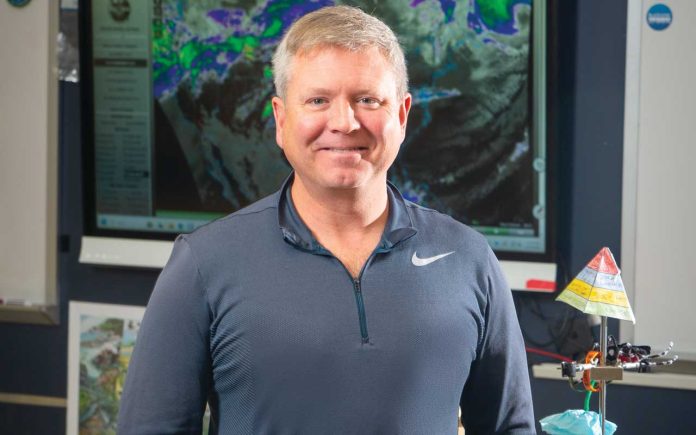

Ever wondered how air conditioning works, how Canadian wildfires affect weather patterns in the continental U.S., or just how high local sea levels are rising? Ryan Miller has the answers. And he loves to enlighten anyone who’s curious.
Beyond his classroom at Washington-Liberty High School, where he teaches environmental science, physics, astronomy and geographic information systems (GIS), you may have seen him on the air. As a meteorologist with NBC’s Storm Team4, Miller covers weather segments, mostly on weekends and holidays. He’s also filmed more than 130 installments of Science 4 Everyone, an NBC4 series of educational snippets on a range of scientific phenomena.
One episode from December 2024—about why some people tolerate cold temperatures better than others—garnered 1.3 million TikTok views. (The answer, he explains, involves differing degrees of skin responsivity, the climate you grew up in, and a psychological component. Seeing others bundled up might make you feel chilly, too.)
View this post on Instagram
Miller’s on-air lessons aren’t always confined to a green screen studio. He heads to the beach to explain why storms hit the East Coast far more often than the West Coast. He treks through the woods to demystify why mushrooms appear after it rains. He’s hit the streets of Arlington to converse with members of the county bomb squad about how explosives work.
Off the clock, you might spot him hiking around Theodore Roosevelt Island, walking his dogs at Potomac Overlook or golfing at Army Navy Country Club. “My current handicap is 13,” he says sheepishly, “but I’m working to bring it down to a braggable number.”
What’s funny is the Akron, Ohio, native became a media personality by accident.
Miller was teaching a class at W-L in 2003 when a student asked a weather question that left him stumped. “It was related to tornado formation in southern Maryland,” he recalls. “The student was curious if wind patterns along the river contributed to more tornado reports in places like Charles County.”
To determine the answer, he reached out to Doug Hill, then the chief meteorologist for local ABC affiliate WJLA-7. They struck up a conversation, and Hill shared that his producer had just quit. The school year was wrapping up and Miller had time to spare. The station asked him to sub in as its meteorology producer for the summer.
That side hustle ended up lasting far longer than one summer. In 2004, Miller pivoted to an on-air role. In 2021, he jumped to rival station NBC4 Washington, where he remains today.
View this post on Instagram
Toggling between teaching and television isn’t easy, he admits, but his school and studio hours don’t overlap much. “The bonus is that I love both jobs,” he says. “I don’t mind when things get crazy.”
During the pandemic, to fill a programming void for the station, Miller began hosting a daily hour-long show, Outside the Classroom, featuring at-home education lessons and science experiments. Several fellow Arlington Public Schools teachers made guest appearances, including Donna McConnell, then a reading specialist for APS. She and Miller started dating and now live together in Arlington’s Bluemont neighborhood.
His enthusiasm for science is contagious. Some former students, inspired by his class, have pursued college degrees and careers in scientific fields. A recent post to his approximately 4,000 Instagram followers asked former students to share classroom memories. One alumna reminisced about the time Miller challenged students to bring in songs with astronomical or meteorological terms. (His favorites are Rihanna’s Umbrella and Prince’s Purple Rain.)
This year, his Environmental Systems and Societies class includes an unusual student: his 16-year-old son, Seaton. “He isn’t supposed to enroll with me,” Miller says, “but we got special permission because I’m the only teacher in the county who teaches that subject.”
Just Curious
We asked Miller to shed light on some timely scientific queries.
Why are we supposed to kill spotted lanternflies?
“These invasive insects have voracious appetites for all things plants. Vineyard and orchard owners are terrified they will take over and cause issues for crops. Newer research shows that our native bat populations might eat them, which would be a good thing.”
Will we get any snow this winter?
“We’re starting to see a shift from El Niño to La Niña conditions, but there’s still a chance we could get one or two storms if the cold air and moisture off the ocean align.”
How is climate change impacting the DMV?
“We’re very vulnerable, with our recent dry conditions. If the Potomac River level drops below the giant intake pipes, there’s only one day of reserve drinking water as a backup, and we could be in big trouble. It’s not just here. Elsewhere in Virginia, in West Virginia and Pennsylvania, recent drought conditions were far worse than ours, and those areas feed the Potomac.”
Have federal funding cuts to science agencies affected your job as a meteorologist?
“The money that’s been cut goes into collecting data reliably, getting that data into our models to make accurate weather predictions. The National Weather Service, National Oceanic and Atmospheric Administration, and the folks who work there are only as capable as the money that’s allocated to them.”
Arlington writer Jesse Rifkin is a dueling pianist at Georgetown Piano Bar.