America’s semiquincentennial has prompted celebrations from sea to shining sea, including traveling history exhibits, block parties, volunteer days of service and patriotic performances. This year’s July 4th festivities will go out with an extra bang as the nation honors the 250th anniversary of the signing of the Declaration of Independence.
But at George Washington’s Mount Vernon, the date is always somewhere in the vicinity of 1776. A visit to the estate’s impeccably preserved mansion, grounds and working farm finds life much as it was two and a half centuries ago.
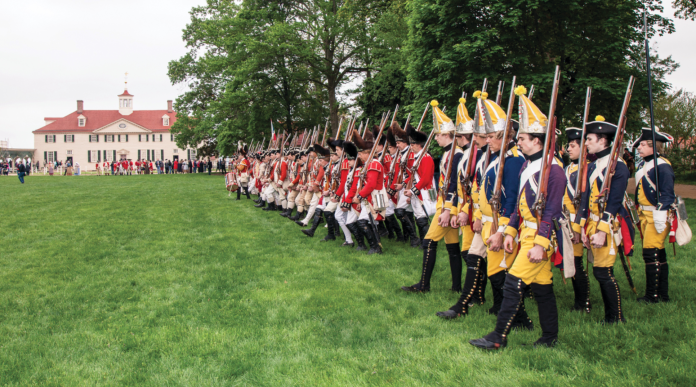
Each year in May, some 400 historic reenactors converge on the Potomac riverfront property for the annual Revolutionary War Weekend, putting their modern-day identities aside to assume colonial personas.
Soldiers donning hand-sewn breeches and tricorn hats march in formation, armed with muskets and bayonets and shouting “huzzah” under the smoke of cannon fire as they recreate key battles and skirmishes between the Continental Army and redcoats.
Some pose as Hessians, the German mercenary soldiers who fought alongside the British, identified by their distinctive metal headgear.
Actors portraying England’s King George, the Marquis de Lafayette and Washington himself receive top billing.
For visitors, this immersive living-history event offers an illuminating window into 18th-century life in Virginia. Tent encampments populate the grounds, women in period garb cook over open fires, and artisans sell sundries such as handmade pottery, soap and rustic bread. Nurses tend to wounded soldiers in the field while youngsters gather kindling and fetch water. The mood is one of excitement, camaraderie and steely resolve.
On May 5, 1776, General Washington, in a letter to John Hancock, expressed concerns over the fate of The Cause: “The designs of the Enemy are too much behind the Curtain, for me to form any accurate opinion of their Plan of Operations for the Summers Campaign,” he wrote. “We are left to wander therefore in the field of conjecture.”
Plot spoiler: The Continental Army prevailed. May the American Experiment continue.