
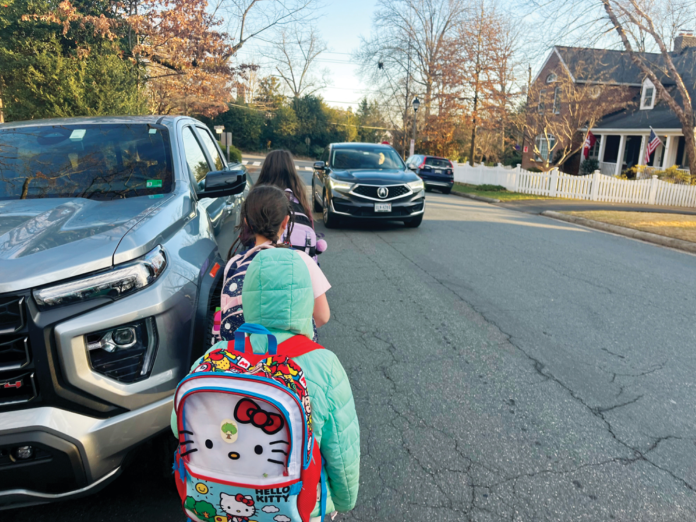

Connecting a three-block stretch of a leafy Arlington neighborhood near a couple of parks lies an unassuming sidewalk. Other than the young trees alongside it and the caution-yellow curb ramps, there’s nothing remarkable about this patch of pavement—except for the fact it was eight years in the making.
Pete Erickson’s vision for it began in 2012 when he moved to Tara-Leeway Heights with his wife, Sabrina, and their two young kids. Though they liked their new home, they were concerned about the lack of sidewalks along their street. In the years that followed, the county opened the new Cardinal Elementary School nearby and more children walked past their house. Erickson asked the county if there were any plans for a sidewalk on his block—a question that sent him down a years-long path lined with red tape.
“I had no idea about this process when I started,” he says.
Erickson was referred to his local civic association, which then connected him to the Arlington Neighborhoods Program (ANP) to facilitate his sidewalk proposal. As a newly minted “block captain,” he set out to gather buy-in, going door-to-door in 2017 with a clipboard, a petition and the hope he could garner support for a sidewalk from at least 60% of his immediate neighbors.
“We were so naïve,” he recalls. “We’re thinking, ‘Hey, wouldn’t that be great? Doesn’t everybody want to have a sidewalk on our street?’ No. We started to get a little hint that there was going to be some resistance.”
A couple of years later, the project was ready for round-two approval. “That’s when things kind of got ugly,” he says.
Neighbors who opposed the sidewalk had concerns about the potential loss of trees or the possibility it would shrink their driveway footprint. A few accused Erickson of falsifying petition signatures and threatened to submit a FOIA request to the county for the records. Opponents distributed flyers urging fellow residents to thwart the effort.
Despite the pushback, the sidewalk was ultimately approved and built, with construction and landscaping wrapping up in October 2025. Last fall, Erickson was pleased to see Halloween trick-or-treaters trotting down the sidewalk rather than walking in the street. But the project took a personal toll.
“There are neighbors who will not talk to us,” he says.
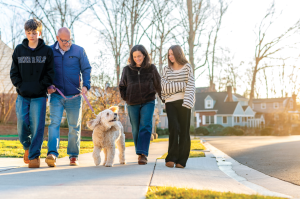
Tara-Leeway Heights is a pocket of mostly single-family homes within walking distance of shopping hubs, VHC Health and several schools.
Like much of Arlington, it was rural when the first homes were built there in the 1930s. But as federal government jobs proliferated and new transportation modalities connected Arlington to D.C., land that had been home to dairy and grain farms became suburbanized. Subdivisions sprang up around railroad and streetcar lines, and eventually, around roads fashioned for automobiles.
As developers courted prospective homebuyers, sidewalks were among the advertised “amenities” in certain neighborhoods, says Arlington County historian Lorin Farris.
“A way that [a development] boasted its difference to other neighborhoods was by saying it has paved roads, it has sidewalks, there’s water and sewer infrastructure, there is a central community park,” Farris says. “That would have been seen as very enticing, very exciting, to live in a neighborhood like that.”
Demand for housing climbed during and after World War II, and Arlington’s population grew by 137% between 1940 and 1950, according to county records. Some subdivisions featured sidewalks and other perks, but many were built with incomplete sidewalks, or none at all.
Today, pedestrian walkways are an ongoing topic of conversation in Tara-Leeway Heights. In the neighborhood’s 2005 conservation plan (its most recent), residents identified traffic/speeding as its biggest drawback. Missing sidewalks were mentioned multiple times as a safety concern.
What developers a century ago pitched as nice-to-have are today considered by many to be a necessity, particularly as the county becomes more urbanized. According to the Federal Highway Administration, sidewalks can reduce collisions between vehicles and pedestrians “walking along roadways” by as much as 89%.
And pedestrian deaths are on the rise. A 2025 Washington Post investigation of fatalities nationwide involving pedestrians and cars showed a 70% increase in such incidents between 2010 and 2023.
In Arlington, 21% of county-maintained streets lack sidewalks, and another 15% are in “fair” to “very poor” condition, according to 2024 county data. The county’s Master Transportation Plan, adopted in 2007, sets a goal to “provide safe and convenient pedestrian access” on all Arlington roads. The plan defines pedestrians as a broad group, including people using walkers, wheelchairs and scooters for mobility.
“At some point, everyone is a pedestrian,” the plan states. “Almost every transportation trip includes a portion taken by foot or wheelchair, making pedestrian safety, access and mobility critical to [the] success of the entire transportation system.”
Mike Doyle spends a lot of time thinking about pedestrian safety. In 2016, he was walking home from work in Old Town Alexandria when an SUV struck him in a crosswalk.
“The next thing I knew, I was on the ground,” he says. The impact of the collision left a dent in the hood of the vehicle, but the damage to Doyle was far worse. In addition to broken bones and nerve damage, he sustained a brain injury that required three years of neurological rehabilitation and another year of cognitive recovery.
A few months after the accident, Doyle learned that the City of Alexandria had adopted Vision Zero, a program aiming to eliminate severe traffic injuries and deaths by 2028 via infrastructure improvements and other measures. Modeled after a Swedish initiative that debuted in 1997 with promising results, Vision Zero has since spread to municipalities across the U.S., including Arlington, which adopted its own version in 2021.
But Doyle bristled at the idea of waiting a decade to achieve safer streets. He joined a handful of friends to launch Northern Virginia Families for Safe Streets (NVFSS), an advocacy group pushing for safety improvements that also provides workshops at area schools. NVFSS worked with graduate students in the urban planning program at Virginia Tech to create an online dashboard of dangerous and “near miss” locations for pedestrians in Northern Virginia, using crowdsourced and Virginia traffic records data.
Doyle sees sidewalks as a “critical” piece of the safety equation. NVFSS is currently assessing high-traffic areas with missing sidewalks, including several blocks near Columbia Pike.
Arlington’s Vision Zero program, meanwhile, has begun implementing “quick-build” safety measures such as median refuges (pedestrian islands) and signage in high-risk intersections. County statistics suggest these upgrades may already be helping. Critical crashes were down by 24% in 2024 versus the prior year.
Vehicle-on-vehicle crashes still account for the largest share of severe and fatal accidents in Arlington, but collisions involving cars and pedestrians are second. Of the 750 “critical” crashes that have occurred within county lines since 2013, 202 involved pedestrians.
Wouldn’t sidewalks improve those numbers? Absolutely, says Vision Zero program manager Christine Baker, but that’s a lot of terrain to cover. Installing a sidewalk on every county street would be “lovely,” she says, except that the cost of doing so is prohibitive.
Sidewalks become an equity issue when you consider that not everyone has a car. For folks who are hoofing it to work or the store (or walking from a Metro station or parking garage), sidewalks provide connectivity and safe passageways between neighborhoods and commercial districts.
In Arlington, a revised Master Transportation Plan slated to wrap up this summer establishes six goals—among them, ensuring that Arlington’s transportation system is “equitable and inclusive.” This is partly in response to a public engagement period, during which county residents identified “equitable access to transportation” as a core need, particularly for low-income people and those living in underserved areas.
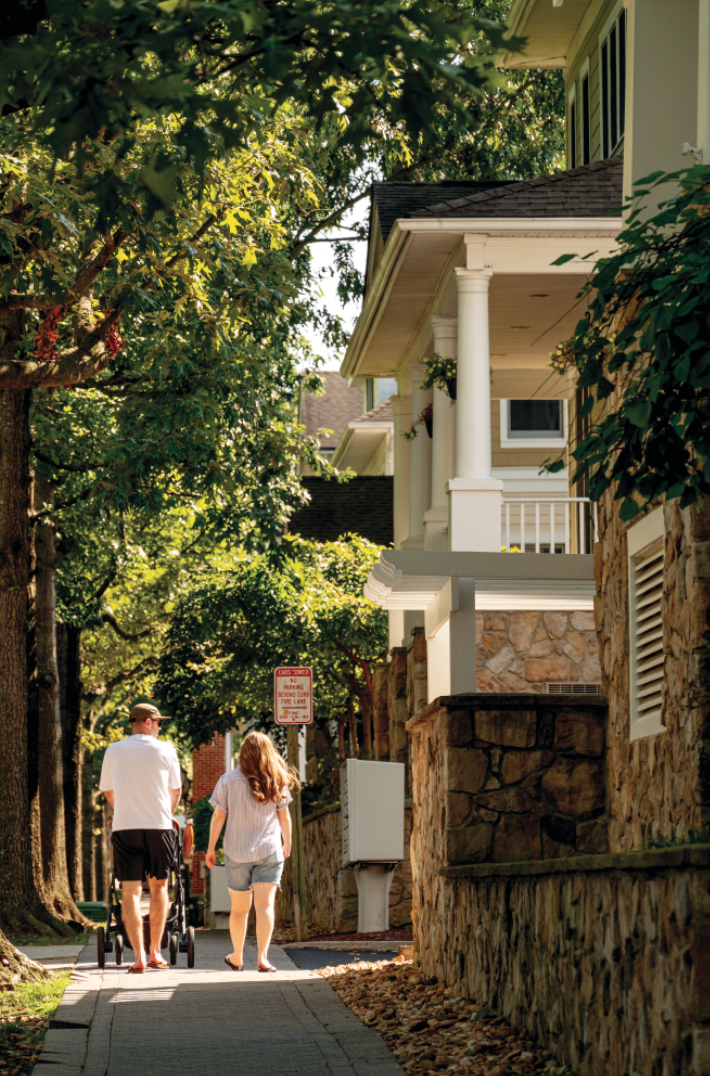
According to a 2023 Arlington Vision Zero report, car crashes occur twice as often in places identified as “equity emphasis areas”—neighborhoods with lower incomes or higher non-white populations than the county as a whole—in part because of their proximity to congested arterial roads with vehicles moving at higher speeds.
The report also revealed that citizen requests for street improvements through the county’s Neighborhood Complete Streets (NCS) program were lower in equity emphasis areas—perhaps because the process is so opaque and time consuming.
NCS program manager Michelle Stafford says she receives a few dozen requests for neighborhood improvements in Arlington each year. Many are pleas for new sidewalks.
“They’re crucial infrastructure for people to travel in our county,” Stafford says. “Kids learn how to ride their tricycles on them. I think they provide a leveling [effect] in society for people who aren’t able to drive a car.”
However, the need is far greater than the county’s ability to deliver. “I wish we could wave a magic wand and provide everybody with a sidewalk,” Stafford says, but there are funding limitations.
In Arlington, public sidewalks typically cost about $750-800 per linear foot, according to the county’s Department of Environmental Services (DES). Factor in design and elements such as curb ramps, gutters and utility upgrades, and Stafford says the cost of a new sidewalk spanning one block averages $700,000 to $800,000. Stormwater requirements and other mitigating circumstances, such as the need for water main replacement, can send the price tag even higher.
For fiscal year 2026, Stafford’s program was allotted about $1.34 million. Of the 20 to 30 requests that cross her desk each year, NCS is able to greenlight only a couple with county board approval, although NCS isn’t the only channel for sidewalk-seekers.
Civic associations can also submit sidewalk proposals through the Arlington Neighborhoods Program (ANP), an initiative launched in 1964 (then known as the Neighborhood Conservation Program), to empower residents to protect and improve the places they call home. Some of ANP’s earliest approved plans supported infrastructure upgrades in the historically Black neighborhoods of High View Park and Arlington View.
Today, ANP continues to offer a pathway to publicly funded sidewalks, streetlights and other neighborhood improvements, although its budget can’t possibly accommodate the backlog of requests from the 49 civic associations (out of 61 countywide) that are ANP members.
“You can do a lot if you have the money…but if you don’t, you can only go so far,” says John Kirkpatrick, immediate past chair of ANP’s Arlington Neighborhoods Advisory Committee (ArNAC), which evaluates priority projects submitted by civic associations before presenting them to county staff and, ultimately, to the county board.
In addition to sidewalks, ArNAC also reviews requests for streetlights, traffic calming measures, ADA-accessible curb ramps and bike lanes. Kirkpatrick says ANP funding for sidewalks can range anywhere from $1 million to $5 million in a given year.
According to DES, it’s nearly impossible to tease out how much the county spends annually on sidewalks, since pedestrian walkways are often part of larger transit projects or site plans for redevelopment.
“[For] a resident who wants a sidewalk, it’s kind of confusing right now for them to understand where to start,” Kirkpatrick says. ANP has a subprogram, Missing Link, focusing on small sidewalk extensions. Another county division handles sidewalk repairs and maintenance. Factor in Vision Zero and NCS, and the latticework of decisionmakers can be hard to navigate.
To avoid overlap, Stafford says NCS keeps tabs on proposals that have already been reviewed by ANP, but there is no formal connection between the two groups.
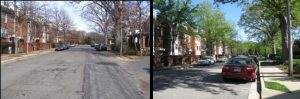
Money aside, the bureaucracy can drag a project out for years—if the sidewalk gets built at all.
Consider what’s involved when petitioning for a sidewalk through ANP. Residents must first connect with their local civic association to outline the project (meaning they must live in a neighborhood that has a civic association, and that association must be an ANP member). Next, the petitioners must gather approval from at least 60% of affected residents (homeowners who live on either side of the street where the project is proposed) via clipboard survey. Then comes a design round, after which they are required to gather at least 60% approval for the design, and obtain the civic association’s blessing as a “first-priority project.”
Civic associations may submit only one project to the advisory committee per funding round, and funding rounds occur twice a year. ArNAC evaluates priority projects using a point system and recommends select projects to the county board. Once a project is approved, ANP and county staff work with the neighborhood on the remaining design and evaluation steps and, ultimately, construction.
But getting a go-ahead from the county board doesn’t guarantee smooth sailing. Proposed sidewalks are further subject to local, state and federal regulations, including mandated clearances for emergency vehicles. (The county does not manage interstate highways that pass through Arlington, or state routes, which are overseen by the Virginia Department of Transportation.) Add to that considerations around environmental preservation and parking supply. “We’re really constrained in a lot of ways,” says Dan Nabors, Arlington’s acting deputy director of transportation.
“One of the real challenges is, where does a sidewalk make sense, and where is it even possible?” says Stafford of NCS. “[Residents] just want a sidewalk. They don’t want to get into the nitty gritty of why it can or can’t work, [yet] we keep adding layers of regulation.”
Sidewalk proposals may also be stymied by neighbors who don’t want them. Kirkpatrick says it’s common for the opposition to grow more vocal during the final petition phase of the proposal process.
“That seems to be when you run into some speed bumps,” he says. “It’s not unusual for a few people to get very active against the sidewalk, whether it’s because they’re losing parking, they maybe have done some landscaping work too close to the street and they don’t want to lose that … or for whatever reason, they just don’t want it.”
It’s important to maintain policies that allow people to voice their misgivings, he says. “At the same time, we can’t let a few people sink a project that benefits many.”
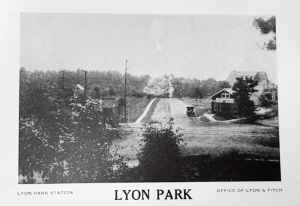
Elizabeth Sheehy, a 25-year resident of Lyon Park, feels sidewalks are important on streets with heavy foot traffic, but she doesn’t want them on her quiet, tree-lined block. She says the absence of paved walkways makes the setting feel more “rural.”
Vehicles travel down her street more slowly than on neighboring roads, she says, theorizing that drivers may be more cautious on streets without a barrier between cars and pedestrians.
Sheehy serves on the executive committee of her neighborhood citizens association. She views Arlington’s decentralized process for sidewalk approvals as inefficient, at best.
“They’re not doing it holistically,” she says. “They’re doing it to check a box and say, ‘If people want sidewalks, then they can petition for sidewalks.’ But they’re doing it one block at a time or two blocks at a time. So then it’s costing a fortune…and it’s putting a big burden on the community.”
She, too, has seen sidewalks and similar projects wreck friendships. “If a neighborhood decides they want to put a sidewalk in, then that’s great,” she says.
“I know neighbors who are not talking to each other anymore because of sidewalks being put in, because of the burden on neighbors to come to consensus.”
Gathering buy-in is a major time commitment for sidewalk advocates who may also be busy juggling work and family responsibilities. Jon Ware, president of the Tara-Leeway Heights Civic Association, is all too aware of the time block captains spend answering questions from neighbors and trying to secure petition signatures.
“It’s a really significant time and emotional investment on the shoulders of one or two particular people on a block,” he says.
Ware has lived in his neighborhood for a decade and has served in his leadership role for about a year. He says he’s seen “extremes on both ends” of debates over sidewalk proposals. Managing disputes is an additional burden placed on block captains. “You’re the point person for the two extremes,” he observes. “[It’s] difficult to keep going…when you can have some very intense feelings being thrown at you.”
In recent years, Arlington has taken a “multipronged approach” to pedestrian safety, according to Nabors, the county’s acting deputy transportation director. Tactical speed bumps and speed cameras have been introduced in school “slow zones” through Vision Zero, and hardened centerlines have been installed at intersections to effectively slow left-hand turns.
“A lot of it is piloting, testing new things and seeing if it works,” Nabors says. “If it does, great. If it doesn’t, then we try something else.”
The Vision Zero team is currently drafting its next five-year action plan, “doubling down” on the proven successes of quick-build projects, while also exploring new ones, says Vision Zero program manager Baker. “We know it’s not just one single thing that’s going to get us to a safer transportation system,” she says. “It’s the engineering, the enforcement, the behavior-change kind of work, the public health work, all coming together to give us the results we want to see.”
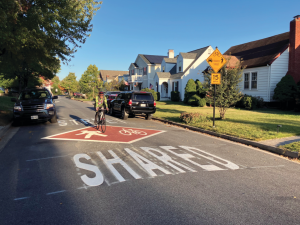
In 2024, NCS launched a pilot program testing the concept of “shared streets” in three Arlington neighborhoods with limited or no sidewalks—Arlington Ridge, Bluemont and Douglas Park. The pilot involved installing signs and pavement markings to remind drivers, walkers, runners and cyclists that the roads were meant to be shared. In a follow-up survey, pedestrians, cyclists and scooter riders reported a boosted sense of safety, but drivers and transit riders said they felt less safe. Survey respondents asked for additional safety measures, including sidewalks.
Tara-Leeway Heights resident Erickson says one change that could make sidewalk approvals less cumbersome (and less perilous for folks reluctant to antagonize their neighbors) would be to shift the burden from residents back to the county, with county staff serving as block captains and shepherding projects to completion.
“There are neighborhoods where there’s a sidewalk and suddenly it stops,” he says, “because owners have the say in whether or not there’s a sidewalk in front of their house. If there was something happening that I didn’t want, but I didn’t have a say, maybe I would be upset. But when it comes to safety, I think we all owe it to each other to try to create a safer street.”
His suggestion could come to fruition. Last year, County Manager Mark Schwartz told the county’s pedestrian and bicycle advisory committees that he’d like to see a comprehensive sidewalk completion plan, which would potentially shift the legwork from residents to local government. “At the end of the day, if we’re going to be pedestrian-friendly…that has been an obvious missing piece,” Schwartz said.
Arlington has no immediate plans to amend its existing channels for sidewalk approvals and construction, says a DES spokesperson. Should the county choose to move in this direction, it would in most cases need to obtain easements to build sidewalks that cross private properties in residential neighborhoods.
In the meantime, Erickson and his family are enjoying their new sidewalk. He says the eight-year-long process was “worth it,” despite the tribulations.
“Improving neighborhoods takes effort,” he says, adding that he formed some new friendships along the way.
“The positive is, I know everybody who lives on the street now.”
Eliza Tebo is a writer, musician and podcast host covering creativity and culture in the D.C. area and beyond.