Heading outdoors? You may want to throw on some long pants and a hat—even if it’s hot.
Ticks are out in record numbers this year. The Centers for Disease Control and Prevention reports that emergency room visits for tick bites are at their highest level nationwide since 2017. In Virginia, more than 1,700 people visited emergency rooms for tick bites and tick-related illness in April alone, according to the Virginia Department of Health.
Arlington’s Department of Human Services does not track tick bites as a reportable condition, but it does track tick-borne illnesses such as Lyme disease, spotted fever rickettsiosis, ehrlichiosis and alpha gal syndrome. Visits to local ERs for those conditions have increased slightly this year, but still remain low, says a county spokesperson.
Not all ticks carry bacteria that can sicken humans, but the mid-Atlantic region has seen an increase in cases of Lyme disease, the most prevalent tick-borne illness. Lyme is transmitted when the bacteria from a tick bite enter the bloodstream.
The first reported case of Lyme disease in the U.S. dates to 1977 in Old Lyme, Connecticut, hence the name. In the worst cases, Lyme can cause long-term neurological problems. However, it is easily treatable with common antibiotics, and lifelong illness is rare. About 476,000 Americans are diagnosed and treated annually, according to the CDC.
What’s Causing the Increase?
Heat and humidity are a factor. Ticks thrive in temperatures warmer than 45 degrees and with 85% humidity, so summer in the mid-Atlantic provides ideal conditions for them.
Plus, people are outside more when the weather is warm, increasing the potential for exposure to ticks, says Christopher Walsh, an internal medicine physician at VHC Health.
“The increase in ticks this season likely has to do with two factors: mild winters, which allow more ticks to survive and breed in the spring, and an increase in human-to-vector contact,” Walsh says. “The ticks need other animals, such as deer, mice and squirrels, to survive. The more proximity humans have to these animals in their neighborhoods, parks and backyards, the more potential for human tick bites.”
How to Spot a Tick
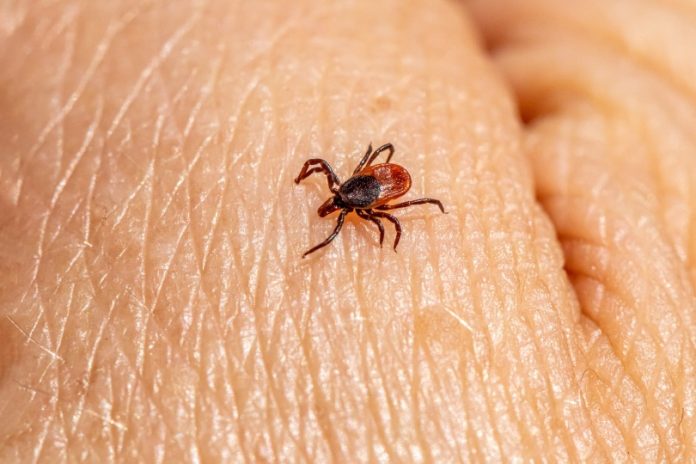
Blacklegged (aka deer) ticks are the only ticks that carry the bacteria that causes Lyme, according to the Virginia Department of Health. They pose the biggest threat in late spring and summer, when more people are outside and the insects are in their nymph stage. “Blacklegged tick nymphs are tiny (about the size of a poppy seed), and their bites cause very little or no itch or irritation,” according to the state agency. “Most people never realize they have been bitten unless the tick attaches to a part of the body in plain sight.”
Symptoms To Know
Lyme symptoms can take anywhere from three to 30 days to appear after an initial tick bite as the bacteria works its way through the body.
One telltale sign is a target-shaped rash resembling a bullseye at the site of the bite, but that appears in only 60% to 70% of cases, says Meredith Porter, medical director for the Inova-GoHealth centers. Other symptoms, including fever, headache and body aches, may develop within about seven to 10 days after a bite.
Additional symptoms that can arise anywhere from three to 10 weeks later include extensive rashes, neurological issues (such as tingling), irregular heartbeat and arthritis, especially in the knees. If those occur, go to the emergency room, Porter says.
Symptoms are largely the same for people of all ages, but children are more likely to have fevers and facial nerve palsy. Kids are also more likely to present with knee swelling from arthritis. Adults are more likely to feel nerve pain in their extremities, she says.
If you feel ill and test negative for the flu or covid, or if you saw a tick on your body, visit a doctor for a blood test that can detect Lyme.
If the test is negative for Lyme, ask about tests for ehrlichiosis and babesiosis—two other tick-borne diseases that are rare but present in our area. Ehrlichiosis is an umbrella term for diseases stemming from three types of tick-borne bacteria, while babesiosis is a disease caused by a parasite spread through deer tick bites.
“Other tick-borne illnesses such as Rocky Mountain spotted fever, human monocytic ehrlichiosis and human granulocytic anaplasmosis are all characterized by acute fevers, rash and often neurologic symptoms such as headache, neck stiffness or confusion,” Walsh says. “Any illness with high fevers and rashes should be evaluated by a healthcare professional.”

How to Treat Tick-Borne Illnesses
An antibiotic called doxycycline treats several tick-related infections, including Lyme. “When acute Lyme is suspected, treatment involves a short course of antibiotics over the course of 10-14 days,” Walsh says. Amoxicillin and cephalosporin also treat Lyme.
Rarely, patients may experience long-term effects, such as systemic rashes and neurological symptoms like Bell’s palsy, which causes paralysis on one side of the face. Arthritis has also been linked to Lyme. Only 5% to 20% of patients develop chronic symptoms after contracting Lyme, according to Columbia University’s Lyme and Tick-Borne Diseases Research Center.
“Lyme disease is divided into three categories: early localized (days to weeks), early disseminated (weeks to months) and late disease (months to years), depending on the time from tick exposure,” Walsh says. Disseminated Lyme can present as cardiac or neurologic issues, while late disease is almost always an arthritic condition in one joint, often the knee. A longer course of antibiotics can help with both.
What to Do If You Find a Tick
The sooner you remove a tick the better, to limit the transmission of bacteria. Spotting and removing the bug within 24 hours is ideal, Porter says.
“In urgent care…we’ll see people coming in [because] they found a tick, and either they can’t get it off themselves or they’re worried about getting it off or they want us to get it off,” she says.
To remove a tick yourself, use tweezers to grab it as close to the skin as possible. Then, squeeze gently and use upward pressure to pull it off. Avoid twisting it, as doing so could cause the pincers to stay embedded in your skin.
If that happens, don’t dig at the bite, Porter advises, as doing so can injure the skin. “Just clean it really well with some rubbing alcohol. Your body’s going to expel those little mouth parts. As long as the tick is not alive, it’s not going to be able to pass on Lyme disease or an infection that is a tick-borne illness.”
If you do get a bite and remove the culprit, you may send it out for analysis. In Fairfax County, which includes Falls Church and McLean, the health department’s free tick identification service has received about 100 ticks so far this year from residents who want to know what kind of tick bit them—information that helps in treating any illness that might result. You can also send specimens to VDH’s Virginia Tick Survey for identification and related information about diseases associated with that type of tick.
How to Prevent Tick Bites
Doctors and the Arlington County Department of Human Services recommend taking these steps to prevent tick bites:
- Walk in the center of trails, avoiding tall grass and brush.
- Wear light-colored long pants and long-sleeve shirts so you can spot ticks on them easily.
- Tuck your pants into your socks and boots, and tuck shirts into pants.
- Shower after being outside.
- Throw your clothes in the dryer to kill anything that might be on them.
- Ask someone to do a tick check of your head and body.
- Treat your pets with tick prevention so the insects don’t attach to them, fall off and move on to you.
- Use Environmental Protection Agency-approved insect repellent such as permethrin, DEET, picaridin, IR3535, oil of lemon eucalyptus, para-menthane-diol or 2-undecanone.
“For those individuals reluctant about [using chemicals], I would focus on behavioral steps one can take to reduce tick bites, such as wearing long clothing, tucking in pants legs and shirts at the waist, and routinely performing skin checks for ticks on themselves and any children,” Walsh says.
If you find a tick that hasn’t attached to a person or pet, assume that it still could have bitten you. At that point, you have two options: Wait to see if symptoms develop or visit an urgent care for a one-time dose of doxycycline. Taken prophylactically, the antibiotic can prevent bacteria from multiplying in your bloodstream.
And finally, don’t let let this news put a damper on summer. Ticks can be present all year, anyway. “We want people to be outside,” Porter says. “It’s good to protect yourself year-round.”