Last year, Arlington Community High School’s oldest graduate was 62.
For students who need an alternative path to a high school diploma, ACHS offers a chance to finish their education on their own terms. Open to county residents age 16 and older, the school accommodates students juggling work, family responsibilities and other life challenges, with flexible schedules and personalized instruction.
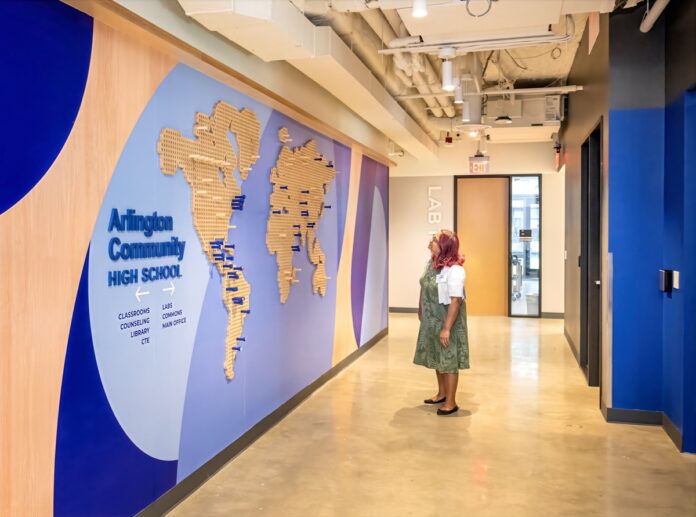
For nearly a century, ACHS had no dedicated home. That changed Aug. 31, the first day of the 2026-27 school year, when the 97-year-old program took up residence on two floors of Amazon’s PenPlace building overlooking Metropolitan Park in National Landing. The tech giant is providing 30,000 square feet of space free of charge, while APS handles maintenance on a 30-year lease.
Up to this point, ACHS led a rather nomadic existence. It was most recently tucked inside a Ballston office building for three years. Before that, it shared facilities at the original Arlington Mill Community Center and then at the former Fenwick Center in the Arlington Heights Historic District.
ACHS principal Jeanette Allen gives the school’s first permanent home an A. “Good things come to those who wait,” she says.
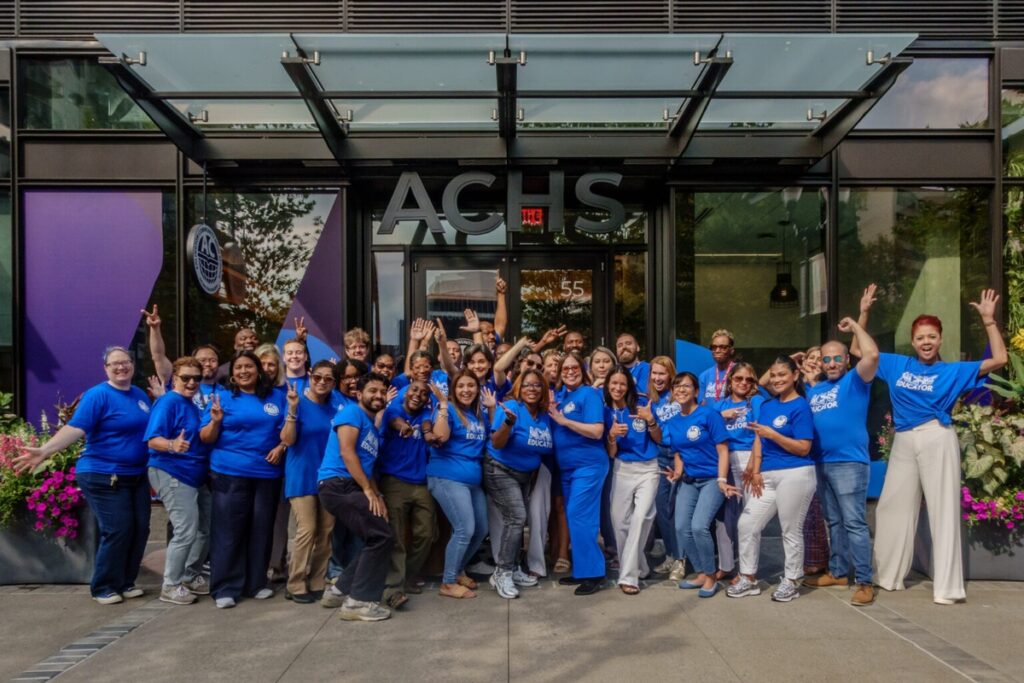
“Our students have, in many cases, had some type of challenge, whether it’s depression or anxiety or different challenges they face,” says Paula Davis, an English teacher at ACHS. “To come from that experience to such a vibrant, centrally located place that is new, that is state-of-the-art, I think it is definitely a big pick-me-up, a big validating feature for them.”
A School Without a Home
The program that is now known as ACHS was established in 1929 as a night school at what was then Washington-Lee High School (now Washington-Liberty). Back then, many students were dropping out of school to work at the start of the Great Depression, Allen says, citing a history of ACHS by Barbara Thompson, ACHS’ principal for almost 40 years, who retired in 2023. Although school records are sparse between 1930 and the 1960s, Thompson’s chronology indicates that alternative education became available as a full-day program under the high school continuation program model.
In 1995, the Arlington Mill High School Continuation Program opened as part of the Arlington Mill Community Center, according to the Arlington Historical Society. In 2012, it became a fully accredited APS high school called Arlington Mill High School. Four years later, the school moved to a building adjacent to the Arlington Career Center and was renamed Arlington Community High School.
Today, ACHS offers a non-traditional path to earning a high school diploma. Untied to geographic boundaries, the school is open to any county resident age 16 or older. There is no upper age limit.
The new location on Amazon’s campus is within walking distance of two Metro stations and sits on multiple bus lines.
“I see this as a true community school because our student enrollment fits the needs of the Arlington community,” Allen says. She was named principal in 2024 after working there as an assistant principal earlier in her career.
“Our goal was to be in an area that was accessible to students,” she adds. “We have no school transportation so they have to get to us on their own. Our advocacy was not for a permanent home as much as it was for accessibility.”
New Space, New Opportunities
The new space in National Landing includes a cafeteria, library and about 20 instructional spaces. The staff of 50 includes 18 full-time instructors, plus a handful of faculty members who work at night part-time.
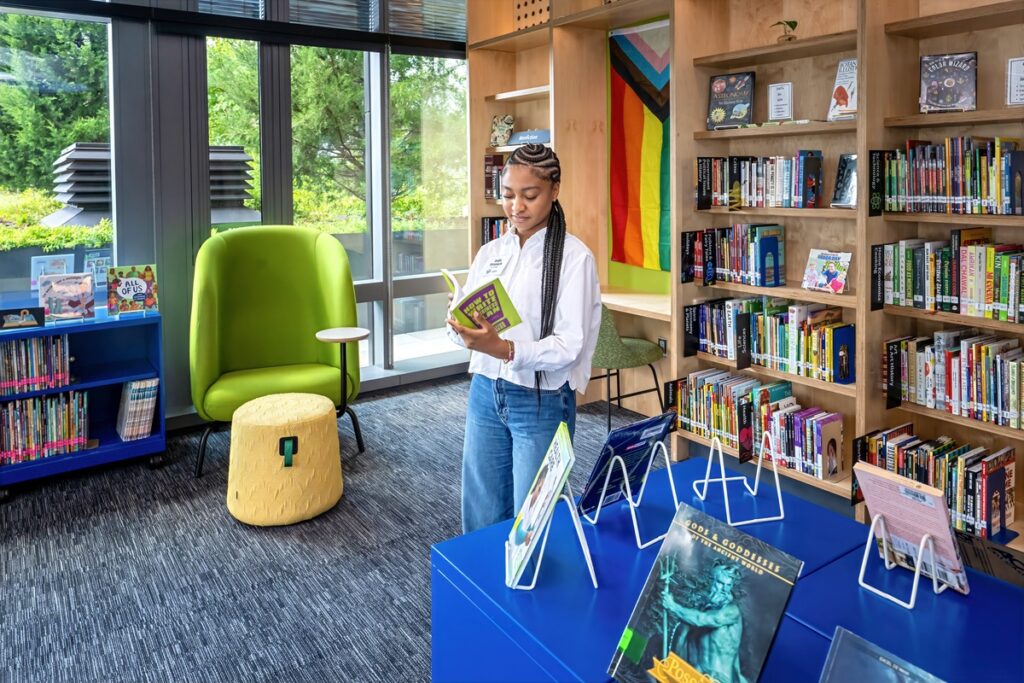
In addition to offering courses required by APS for graduation, ACHS offers career and technical education programs, such as Teachers for Tomorrow, a Virginia program that gives students who want to get a teaching degree experience working in local classrooms.
Students can also take advantage of dual enrollment through Northern Virginia Community College, earning high school and college credits at the same time. There are opportunities to earn industry certifications, too.
Although ACHS doesn’t have varsity sports or a roster of after-school clubs as long as a Cheesecake Factory menu, it does offer extracurriculars. The Kiwanis Club of South Arlington sponsors ACHS’ Key Club, a student-led service organization. Friends of Arlington Community High School, a new group established with $50,000 in seed money from Amazon, will function much like a parent-teacher organization.
“I think we have a very strong partner with Amazon here,” Allen says. “They’re looking for mentorship opportunities, internships, job shadowing opportunities, helping students prepare for the workforce and expose them to different career opportunities.”
A School Built for Second Chances
ACHS can accommodate as many as 300 students, but its enrollment numbers change frequently because students can start and stop as needed. “We served almost 300 students last year, but we maintained an enrollment of 172,” Allen says. Currently, 194 students are enrolled.
That flexibility is central to the way ACHS works. The school offers daytime classes that can be completed in one semester, as well as evening classes that can be completed in a year.
The school uses a proficiency-based learning model. Instead of emphasizing time spent in the classroom, the model compels students to demonstrate mastery of a subject to advance. This enables students to pick up learning where they left off, rather than following a linear path from ninth-12th grades.
“We look at the essential body of knowledge components and identify what they need to know and what they should be able to do, and we track their progress toward mastering all these skills,” explains Davis, who’s worked at ACHS since 2013. That way, students don’t have to take classes over and over again.
“You have your curriculum…and you have students coming in and out and they might demonstrate that they already know X, Y, Z, so then just have to finish [certain parts],” she says. “A lot of individualization and personalization goes into it.”
Meeting Students Where They Are
Students at ACHS come from all walks of life and complete their high school education at different speeds. Some are simultanously juggling the demands of full time jobs and families. One student finished a course in one month. Another who enrolled in ACHS at 16 is still attending at age 20.
“Life circumstances have gotten in her way,” Allen says. “We meet [students] where they are. If they want to run, they can [sprint through the coursework]. If they need to crawl, we give them those supports until they are able to move a little bit more quickly. It’s up to them.”
Davis says all of the students are inspiring. “There’s something special that’s hard to name about working [here]. You get to advocate for students every single day—students who sometimes have felt like this may be their last opportunity to finish high school. Sometimes students will come to us needing that boost, needing that confidence.”